
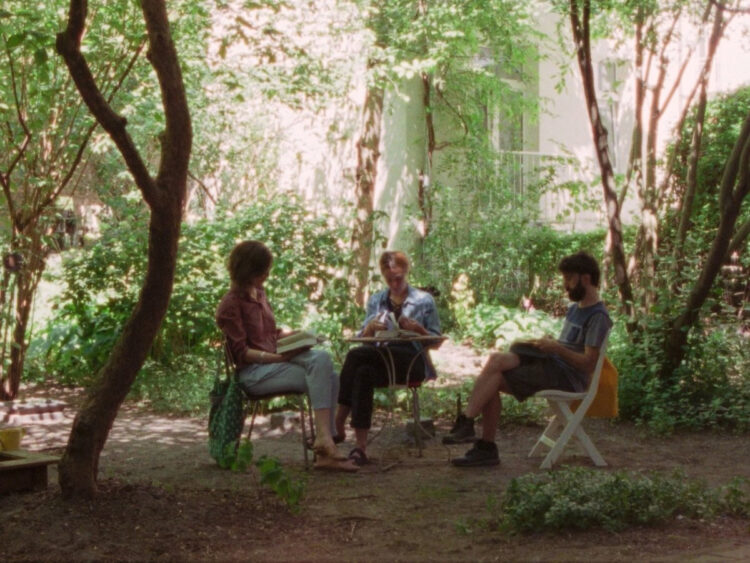

No one moves abroad in Ted Fendt’s Foreign Travel; people walk plenty—mostly around Kreuzberg, Berlin—but the kind of wandering this erudite film is concerned with is chiefly of the mental variety. It is triggered by books, those of Italian writer Anna Maria Ortese, who rose to fame after her death but is yet to find the recognition she deserves outside her home turf. So obsessed with her works is thirty-something Leonie (the film’s protagonist and Fendt’s co-scribe, Leonie Rodrian) that she insists on reading them in German and Italian, convinced that the original will yield more clues as to the strange spell they’re casting on her. Foreign Travel treats Leonie as a detective, Ortese as a sphinx, and her two tomes Leonie studies with a tiny posse of fellow bookworms—The Iguana (1965) and Il Porto di Toledo (1975)—as mysterious scriptures, the kind that, as the young woman beautifully puts it early on, “do something to me: they knock on doors that would rather stay shut.”
How you respond to Foreign Travel won’t depend on your familiarity with Ortese’s work, but on whether you can relate to the unsettling pleasures Leonie experiences and Fendt’s film so often elicits—when diving into a book becomes an act of trespassing, and venturing into someone else’s world is to see yours change through the encounter. Granted, Foreign Travel never exactly romanticizes reading. Stretched across a year, each month a chapter, it follows Leonie as she wrestles with Ortese’s sentences, sometimes alone, often with friends: Hanna (Hanna Döring), a mother-to-be who says the way the author writes is “very stirring and intense”; Alejo (Alejo Franzetti) a Buenos Aires transplant who claims he “gets” Ortese’s prose; and Florian (Florian Model), a university dropout who complains he doesn’t. Leonie herself says the pages are showing some kind of “resistance.” And how to blame her? Il Porto di Toledo and The Iguana straddle fantasy and autobiography, but even at their most oneiric, they don’t seem interested in conjuring escapist worlds so much as in destabilizing that of their reader. Ambiguous, confusing, contradictory, they’re a far cry from what would colloquially pass as “light” stuff; after reciting a particularly dense passage, a wry smile brushes across Florian’s face: “I have to re-read this…”
You might feel just as lost watching Foreign Travel, a film whose hour-long runtime may attract diminutive descriptors but suggests absolutely nothing “small” or “little.” To peg this as a story “about people reading” would be both technically accurate and hopelessly reductive. Fendt and Rodrian’s script has the inebriating, rambling scope of a symposium, stitching together conversations that are far more concerned with philosophy and literary theory than the inner lives of those who take part in them. When Leonie opens up about a bad break-up in a rare pause from her book club’s meetings, the idea that she should exist outside the hours spent swimming into Ortese’s universe is so shocking as to evoke a kind of vertigo. Which isn’t to say you don’t get to know these avid readers; only that Foreign Travel forces you to discover them almost exclusively through their relationship with Ortese’s novels.
Fendt, in other words, invites you to read them read, and what’s so riveting about his film is the way it’s concerned with their intellectual and bodily interactions with these texts. Shot on 16mm by Jenny Lou Ziegel, it traffics in static medium-close-ups that like to linger on Leonie et al as they read these books and physically change in the process: a smile, a puckered forehead, eyes traveling from the page to the world unfurling beyond it. Here’s that rare film that’s supremely attuned to the ways a work of art can insinuate itself into the bodies of those who behold it. So much of Foreign Travel, like the literary fodder that inspired it, remains deliberately opaque. Yet getting lost is part of the charm. “I like being in the dark,” Leonie tells Florian halfway through. “I doubt what I read more and more.”
But the confusion she registers while navigating Ortese’s oeuvre doesn’t entirely account for what you might feel watching Foreign Travel. If Fendt’s film is in any way disorienting, that’s not just a function of all its thorny debates—about the difference between truth and reality, between realism and expressivism—but of the bold engagement it demands from its audience. Foreign Travel sits somewhere between the textual fetishism of Matías Piñeiro’s You Burn Me (a film littered with actual excerpts of the books it draws from and invites viewers and characters to read them together on the screen) and the radicalism of James Benning’s Readers, which only allows you to watch people read in perfect silence, leaving you totally clueless as to what they might be leafing through and encouraging you instead to focus on the physical transformations these pages exert on those who process them. Fendt, in turn, lets you hear Leonie and others recite Ortese’s passages; so much of Foreign Travel consists of shots of young people reading and listening to others do the same aloud. Not once are we shown a paragraph from The Iguana or Il Porto di Toledo, and without the written words as handrail (though for non-German speakers the subtitles will count as surrogate), Fendt implicates you in these people’s efforts to resurrect Ortese’s pages in a way other films could never aspire to. Here, conjuring her imaginary worlds becomes a shared project between characters and spectators.
Foreign Travel demands attention from our wandering minds: we are asked to devote time to people performing an activity which itself requires plenty of it. That might be a lot to ask in a media regime where films that refuse to conform to formulas or easily digestible plots are written off as irremediably pretentious. But if you’re anything like Leonie—if you too once waded into a novel for the sole purpose of luxuriating in its enigmas as opposed to solving them—Foreign Travel may prove a wondrous summation of those dizzying pleasures. At a time when flaunting one’s allergy to reading seems to have become a badge of pride, there’s something almost seditious about a film that celebrates that as a sacramental duty: a means to discover yourself and re-enter the world.
Foreign Travel premiered at the 2026 Berlinale.
The post Berlinale Review: Foreign Travel is a Rousing Ode to the Transformative Powers of Reading first appeared on The Film Stage.
from The Film Stage https://ift.tt/X0ZLhW1


0 Comments