
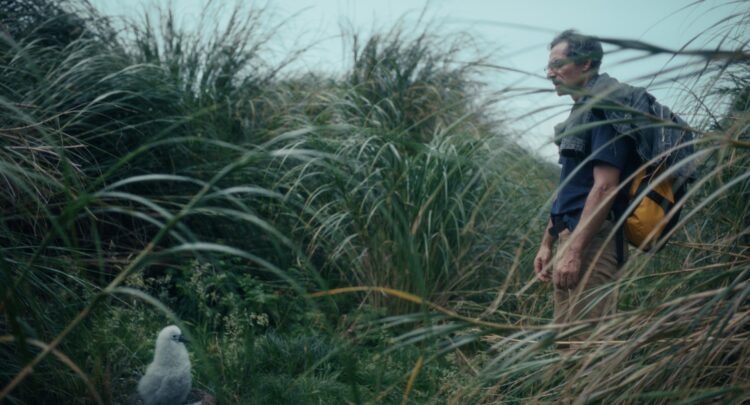
There’s a melancholy to Tobias Nölle and Loran Bonnardot’s Tristan Forever that is comforting. A lingering, existential question hangs over everything: where does one belong? In the film, a Parisian doctor (Bonnardot himself) decides to permanently move to the South Atlantic Ocean island Tristan da Cunha, one of the most remote places in the world. He’s been visiting for three decades, and now wants to make it his home. Labeled a “docufiction,” the narrative hinges on Bonnardot’s adaptability to the remote, spartan lifestyle required on Tristan, along with his pending approval for permanent residency by the island’s council.
Nölle is the credited cinematographer here, and the location is striking. There are unforgettable frames throughout (such as an early one wherein Bonnardot, on a ship, appears surrounded by devastating ocean waves) that underline the uniqueness of Tristan da Cunha. At one point in the film somebody comments that they cannot really believe the island exists. Of course it does exist and it is not easy to live there, something Bonnardot learns quickly. His best friend of 30 years, a fisherman named Martin, gives him a place to stay and does his best to teach the good doctor how to farm and fish and maintain on his own. It does not go very well. Over and over, members of the community ask Bonnardot if he really wants to stay on the island, equal parts skeptical and intrigued. One person asks: “Don’t you like Paris?”
Nölle and Bonnardot intersperse footage from the early 1960s, when the islanders were forced to evacuate Tristan due to the eruption of Queen Mary’s Peak, the summit of Tristan. Once the islanders were on the mainland, the question became: would they go back to Tristan once it was safe? About 230 people live on the island now, and Tristan Forever does a good job establishing the community and its inhabitants. Bonnardot gets a job at a local shop and looks around for a place to live. He refuses to be a doctor anymore, a curious twist early in the picture. Time spent in war zones have left him jaded.
The score from Michael Sauter is both longing and somewhat mystical. It captures the feel of Tristan: a land that time forgot. Life is hard-won on the island; nothing is easy. Yet Bonnardot is searching for something—a new purpose, a new family. We watch as he calls to check on his sick father and very rarely can make contact. Before his sojourn to Tristan, he ended a relationship with a partner. There are moments throughout where his medical knowledge is requested, and he does his best to politely decline. Does Tristan hold the answer he’s searching for? Does anywhere? It’s this quite existential journey that makes Tristan Forever a compelling film. Likely most of us hope there is some perfect place where everything makes sense to us. It’s as aspirational as it is irrational.
Tristan Forever premiered at the 2026 Berlinale.
The post Berlinale Review: Tristan Forever Highlights a Jaded Doctor’s Search for Purpose first appeared on The Film Stage.
from The Film Stage https://ift.tt/8iQIFlM


0 Comments