
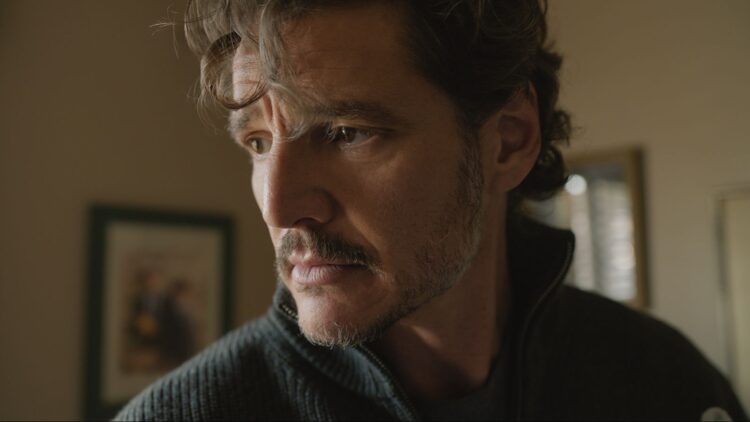
It’s been fourteen years since screenwriter and occasional director Tony Gilroy made an original film, and he’s taking a fresh approach. The filmmaker best known for penning the Bourne films and bringing us Michael Clayton has spent most of his career in spy-coded crime and legal thrillers. (Even his take on Star Wars was procedurally stealthy.) Behemoth! sounds like it could be either, but, in a shift of focus, Gilroy sets his sights on the mundane, aboveboard goings-on of a master cellist.
Described as a “love letter to the music of the movies and the people who make it,” Behemoth! presents more like a winding, tangenting letter than a cohesive narrative, similar to the way reading a series of diary entries might amount to a character study. We follow Alex Serian (Pedro Pascal), a principal cellist in the Chicago Symphony who’s returned to L.A. to look after his dying mother, get back into session work on orchestral film scores, and break free from an ex that gives overbearing a new name.
Deranged ex-lover and institutional string-puller Carol Spedding (Olivia Wilde) bears the spirit of a behemoth herself, lending the movie a sharp comedic edge every time she dominates the screen. In her third extraordinary performance of 2026, Wilde is outrageous as Carol, a top-shelf patron of the Chicago Symphony and a jump scare of eccentricities that can be found popping out of lurking SUVs and marching through restricted areas to hunt Alex down. By the time we meet her, she’s a bona fide stalker, but no one can stop her, and she has no regard for boundaries. When she finally catches up to him (i.e., waits outside his house in L.A.), Alex threatens to call the cops. “My driver is an off-duty sheriff,” she retorts with disgust, offended by the suggestion she’s bound by the law.
The pace is electric for how commonplace the developments in Alex’s life are (new flings, work troubles, people dying), largely because Gilroy plays the metatextual scoring instrument as assuredly as the virtuoso at the heart of his story plays the cello. He transforms what starts as diegetic music in a scoring session for a fictional film into the non-diegetic score of a memory the music triggered for Alex (and vice versa, from the non-diegetic suddenly back into the recording studio). It’s the never-ending magic trick that simply never gets old.
Behemoth! is laced with scoring sessions aplenty, which is where most of the characters in Alex’s life come from. As the grouchy pros tune up to set the mood for a new crime thriller or aching romance that rolls on screens around them, they talk about their personal lives, industry drama, etc., and eventually start recording. For the sake of the film we’re watching, Gilroy makes most of the scoring sessions thrilling or thick with drama, Alex and co. chugging cellos and strings while winds follow suit in an ethereal register, timpanis booming and horns pumping all around them. They seamlessly transition from conversation to complicated composition at the drop of a hat like it’s nothing, merely second nature.
As Alex’s body goes on autopilot, his mind tends to wander, leading us back into periods of his life set in Boston, Dallas, and Chicago. He wrestles with the memories of what happened in each city as he dodges those who want his attention in L.A. in the present. You’d think Alex Serian was Barack Obama or Scarlett Johansson with how desperately everyone is trying to get his time, but no matter how much they claim to love him or have his best interest at heart, Alex isn’t having it. He’ll escape through the underground staff tunnel if he needs to. The constant chase of it all, while mostly comedic, has a classic Gilroy thriller tone embedded in it, meant for spies and three-letter agencies.
Naturally, Behemoth!’s score is a mosaic of pieces provided by a supergroup slice of cinema’s best composers: Michael Giacchino, James Newton Howard, Alan Silvestri, Henry Jackman, Michael Abels, Emily Bear, Lukas Frank, Nami Melumad, and Brandon Roberts. Their work is spread across four fake movies being scored throughout the film, cello practice etudes, fictional TV theme songs, Alex’s father’s compositions, and more. Alongside the metatextual moves, it’s Gilroy’s best idea across the whole film, and it sings with the bravado of a concert of maestros.
It’s fitting that the fictional Behemoth! (one of the four fake movies) is covertly titled Open World in post-production. Gilroy’s diaristic dramedy has an exploratory open world feel to it, as if we’re in a third-person video game, à la Grand Theft Auto, watching player one check off objective after objective—“Escape Carol Spedding,” “Train Underling,” “Watch Video of Dad,” “Hit All Marks in Studio Session,” “Visit Nadia”—to complete the main quest.
Not all of the objectives are compelling to watch, which gives Behemoth! a dullness at times. On top of that, one can’t help but wonder what organic charisma a different leading man might’ve brought to the table. But the rest of the stellar supporting cast (Alia Shawkat, Hank Azaria, Will Arnett, Eva Victor, Thomas Kretschmann) holds the film’s weight. And Gilroy’s vision to bring the scoring process to life through some central to its operation still ends up being a relatively riveting watch.
Behemoth! premiered at the 64th New York Film Festival and opens on December 4.
The post NYFF Review: Behemoth! Crescendos When Focused on the Music first appeared on The Film Stage.
from The Film Stage https://ift.tt/lbqxDcL


0 Comments