

No single home-video release this year, by any remotely comparable margin, generated greater waves than Criterion’s The Complete Kubrick—celebrations of a filmmaker, debates over pricing, and more drops of the word “canon” than a Civil War battlefield. All of this three months before it was released and anybody outside Criterion’s office saw one material shred of 30 4K and Blu-ray discs housed in ornate packaging.
The set is produced by Michael Chaiken, who’d already been ensconced in Kubrick’s world with last year’s Eyes Wide Shut 4K. Between this and archiving credits that read like a miniature history of post-war American art—Bob Dylan (leading to the establishment of the Bob Dylan Center), Nicholas Ray, the Maysles and Safdie brothers, D.A. Pennebaker, Renata Adler, Harry Nilsson, and Norman Mailer, to say nothing of Ousmane Sembène and Isabella Rossellini—needless to say he boasts credentials worth of assembling The Complete Kubrick. With it releasing today, I had a rather extended conversation with Chaiken on the many exhaustive steps that lead to a set of such distinction.
Michael Chaiken: Hi. It’s nice to see you and talk to you.
The Film Stage: It’s good to finally see you.
I loved—and we talked about this, I think over email—the Nigel Galt interview. I’m so happy that happened. I’m so glad that happened because he was so helpful in the course—not only Eyes Wide Shut, but the rest of the box set. And he’s never really spoken publicly before, out of respect for his relationship with Stanley. But I think enough time has passed, and I think that he realized that this Eyes Wide Shut thing is, you know, a serious project, and it was maybe time for him to speak up in terms of how important a role he had in the creation of that film and working with Stanley. And also just to put some of the sillier rumors to rest. [Laughs] Or tried to.
For sure. I appreciate you saying that because I’ve been able to talk to some people I really admire, and that was one of those cases where I was like, “I can just ask you… anything?” [Laughs]
I felt the exact same way! I was like: this guy was in a room for 15 months alone with Stanley Kubrick. He was the only person to see Eyes Wide Shut [at that time]. I mean, he told me that when Christiane [Kubrick], anybody came in the room, the monitor’s off. Nobody saw Eyes Wide Shut in Stanley’s immediate circle until after Stanley passed. Tom Cruise and Nicole saw it, and Terry Semel and Bob Daly and Warner Bros. But it was Nigel Galt who brought the film over to New York. Stanley put him on the Concorde to show it to Tom’s publicity person, and he was in the room with him. And I just said, “This is crazy.” [Laughs] All this talk around this film, like—this is the guy.
He was so generous, and he was so helpful. Because he worked with Stanley for a long time previous to Eyes Wide Shut, particularly on Full Metal Jacket, and he was able to give us some very helpful advice on the audio of Full Metal Jacket and the original mono track. So he was involved through that whole transition after Stanley passed. I mean, biographers have approached him, but he never wanted to go on record. So I loved your piece. I sent that to so many people. I sent it to the Kubrick estate and sent it to a lot of people interested in Eyes Wide Shut because I think it’s a very important contribution if you’re interested in the work of Stanley Kubrick and that film, particularly.
It was like talking to somebody who knew George Washington or something.
[Laughs] That’s a good way of putting it. Yeah, I agree.

Michael Chaiken
To gas you up a little bit, I feel like you’re assuming this mantle as well in the Kubrick history. Not that they’ve ever really been slacking on this sort of thing, but Criterion seems like they’re making more of a habit of the all-encompassing box set: you’ve had the Fellini, the Varda, the Pasolini, the Wes Anderson, Bergman. Kubrick is not at all a strange choice for this. But I’m curious when and how it was decided he’s going to be the next person?
Well, you know, my archive work is kind of my main profession, but I’ve been lucky that I’ve had this parallel career of sorts as an associate producer with Criterion, which goes back a long time, but it’s been about a decade or so that I’ve been helping them with certain discs. And so I got the call at the end of 2024. I was working on the archive of another Bronx-born director, Paul Morrissey, who worked with Andy Warhol, and Kim Hendrickson—who’s an old friend of mine and the executive producer at Criterion—she called me. We had just finished something—it might have been Pat Garrett and Billy the Kid, because I helped them with that—but she said, “Look, we’re thinking.” It wasn’t a foregone conclusion that they were doing a complete Kubrick set. They were going to do something with Kubrick. “Would I be interested?” And it was, like, an immediate, absolute—it didn’t take any deliberation. [Laughs]
There are some people for whom Stanley Kubrick is like a secular religion, and I’m one of those people. So it was like: “I’m in. Tell me what you’re thinking.” And she said, “Well, we’ll get into the details, but we want to start with Eyes Wide Shut” because there wasn’t a 4K master of Eyes Wide Shut, and that would require a lot of work to get that done. So it started there, the end of 2024, and it was in the course of working on Eyes Wide Shut that we met as a group, all the departments met. It dawned on me that, wow, Criterion are in this incredible position because they’ve a history that goes back to the ’80s with Kubrick. They worked with him on his LaserDiscs: they did 2001 and The Killing and Dr. Strangelove, and they have a very good relationship with all the different studios—Sony, Universal, and obviously Warner Bros., who represent now the balance of Kubrick’s career. He signs that deal with Warner in the late ’60s, and I believe Warner Bros. acquired the MGM library from 1968 back, so that now also includes 2001.
So Criterion were like, “Hey, we could do a Kubrick set that includes all these other films.” And then the conversation was, I said, “Well, we’re so close to it being complete.” “Complete” being the independent films: Fear and Desire, his short films. “Would it be possible?” And at the end of the day, those were the trickiest because they were kind of the outliers—whereas, working with the studios, they already had, with the exception of Lolita and Eyes Wide Shut, 4K scans already existed. Criterion have a good working relationship with Universal, Sony, and Warner Bros. So it really was a question of, “Hey, can we do the short films? Can we include that?” And, you know, it took a while [Laughs] but it happened. It happened.
So the other titles, it wasn’t the same amount of lead-up, whereas Eyes Wide Shut required all this work because you’re really starting from zero and you’re building this thing, and working with Warner Bros. and the Kubrick estate. So it was somewhere in the middle of working on Eyes Wide Shut that they said, “Wow, okay, yeah. Let’s go for this. Let’s try to make this happen.” And it was the short films, actually, that were the trickiest. Particularly because Kubrick’s very first film, Day of the Fight, there’s actually two versions. And the version that circulates on 4K is not Stanley’s cut of the film. When he sold his cut of the film to RKO Studios, they re-edited the film—they added some footage, and they changed his narration and the score that he commissioned. So it was a real race at the end. It’s like: “Do we have the elements for his very first, like the original cut?” And it turns out Library of Congress were able to access—they did. And so we were able to make a new 4K scan, and it really reinforces the completeness.
I felt that having Stanley’s very first film effort was just essential; it was key. Even though it might be a small detail for some, if you’re more interested in the later features. Again: it was just researching this stuff and just finding out where this stuff resides. And Criterion being Criterion, they were able to work out the arrangement and the scanning of that. You couldn’t ask for a better partner on that front. So yeah: it was presented to me at the end of 2024, and then about halfway through Eyes Wide Shut it was like, “Okay, let’s see if we can make this complete.” And it took a while before I was like, “Yeah, we did it. [Laughs] We did it.” For a while it was almost, like, The Almost-Complete Kubrick because of the shorts.
I’m definitely the kind of freak who hears “complete” and goes, “You say complete, does that mean…” I do my CTRL+F search. It’s almost too embarrassing to admit. This is not a healthy way to live. You want to check, and there is that longer version of Day of the Fight, which I’m not sure I’d ever seen. And that’s kind of odd because it’s not all material that he shot, right? But it still feels like it’s good to have that there.
100%. Actually, weirdly, he completed Day of the Fight first. But apparently Flying Padre was the first Kubrick film to ever play in a theater, which he finished after Day of the Fight. But the RKO version of Day of the Fight played on the bottom of a double bill of My Forbidden Past. That was obviously the first Kubrick film that most people would have ever seen. So it was absolutely essential that it was on there. And it’s also out there in the world, so people know that as the version of Day of the Fight, so we wanted to be sure.
It’s also interesting to actually watch them back-to-back because they are different. It’s subtle, but they are different. Kubrick’s version ends in a much more existential way. Kubrick’s cut is much more Kubrick in the way that it ends. I mean, if you’re a real scholar, this is the kind of thing that you’d be interested in. But I—much like yourself—really got into the weeds of, “Well, what does this mean to be complete?” And we weren’t going to call it “The Definitive Kubrick” because, absent Stanley, what’s definitive?
A good mindset.
But there is a certain completeness in that these are all of his directorial efforts. And that can’t be argued. But, as you said, to do that meant both versions of Day of the Fight. Both versions of The Shining. The short version of The Shining, the international version of The Shining, is Stanley’s final cut of that film, and so for it not to be preserved… whether you love it or hate it or think “why would he do something like that,” it’s trickier for American audiences who kind of know the longer version. But that’s Stanley Kubrick’s final cut of The Shining, and for it just to be kind of lost would be a shame.
So I was very happy that Criterion were like, “Yeah, if we can do that, and if Warner Bros. agree and they want to work with us on that, we can make it happen.” And they did, and it was awesome. One of the reasons why I wanted Lee Unkrich to do the commentary on the international version was to make it more interesting, I think, for American audiences who might say, “Why would I want to watch a shorter version of The Shining?” [Laughs] But with Lee’s commentary on there, it’s a masterclass, and even if you’re like, “I love the American version. That’s the version I love and know,” having Lee kind of walk you through it and explain to you the changes that were made, on top of all the production history, I think makes it a really rewarding and interesting viewing experience.
The shorter version is different. It is different. The emphasis is slightly different. So it does change things. But like you said: getting into the weeds with this stuff was essential. I mean, most of the time I spent just researching the history of Stanley Kubrick on home video, which for a biographer who’s doing a serious bio on Kubrick—and there’s any number of good ones—that would be like a footnote. But it was a history that I had to delve into and understand, because Kubrick was very interested in how his films were being presented on home video and LaserDisc, and he died before the DVD revolution, and there was obviously no 4K or Blu-ray in 1999. We’re in a whole new realm now, absent Stanley.

It wouldn’t be a Criterion set without the emphasis on the physical product. I haven’t seen, admittedly, the final package, but I noticed that you have the slide-out paper sleeve element to the disc. And I know that can be a little controversial among fans, because there are worries about scratching and the preservation of the discs. From a purely physical standpoint, is there stress-testing that’s done on that sort of thing?
Yeah! I mean, I know that some collectors absolutely hate the sleeve discs, which I was unaware was such a controversy among physical-media collectors. But I trust Criterion because they’re the masters of these things, and apparently their other box sets have a similar design. I know these conversations were happening when I was working with the art department, and they did do some sort of test. There’s a plastic-lined pack to help with the disc going in and out, so it won’t be scraping against paper.
Got it.
[Laughs] But I did ask, “How serious is this?” They said, “We don’t get a lot of returns. If anything, we get a lot of returns from people who have broken the center of the jewel cases.”
Yes. Happens to me.
Those things break in shipping and the disc can fall and stuff like that. But they do—I mean, they definitely test this stuff out. They’re looking at samples that come in. They take all that stuff very seriously. And if it was a serious issue, I imagine it would have greatly affected some of their other box sets. But my role in that is: I’m interfacing with all the different departments to get them exactly what they need so they can do the work that they need to do.
The other thing, too, is: if people absolutely hate sleeves, I am working with Criterion to do standalone editions. So if you don’t want to buy the entire box or you’ve already bought these other excellent editions that have come out on 4K from Warner Bros. or Sony or whoever, there are going to be single editions starting, I think, next year. We’re still kind of working on that, what’s going to happen. So there will be standalone jewel-case editions.
Hopefully that’s not too annoying a question. It’s one of those things where I love getting into the weeds on this sort of decision-making.
Yeah, with the set, my role in all this is really almost like a quarterback. When they initially pitched the film to me, in my mind, I was thinking: you know those Library of America editions, those really beautiful kind of single editions? There was just a Jim Thompson one, and I love those. I have a number of them, and they’re these single compendiums of a particular author. Not only do they have the major works, but there’s also tangential material. It could be important correspondence, it could be archival material, it could be whatever to kind of give a fuller picture. And that was the first thing that came to mind for me in editing the Kubrick box. That was kind of the model: what would a Library of America Kubrick set look like?
There’s been all these great editions—there was a 50th-anniversary edition at Warner Bros. did of 2001 that was fantastic—but what could be additive to that? I mean, they’ve done all these great documentaries, a number of which have carried over. And so a lot of that is just researching what else is out there, what would be new? Kubrick’s fan base is so broad: there’s people who are chapter-and-verse in every scene, every shot, and then there’s people who might know a couple of the films, and then there’s a younger audience who might not know any of these films. And so we could put something together that’s going to grab that huge cross-section of people coming to see Stanley’s work.
So that’s kind of the start of things. And then I work with the individual departments and hear their ideas, their feedback—that goes for the art department, the tech people, the sound people. I might present some top notes. I thought the mono soundtracks were very important, that we could reinstate Stanley’s original mono mixes. But I’m not a tech person, so that would fall on Ryan Hullings, who’s the head of their sound department, and he’s the one that’s pulling things from the archives and he’s doing the sound mix and things like that. So I’m working broadly on what the architecture of the set is, but then I’m working individually with all these different people at Criterion. At the studios, too. It was a very collaborative effort.
Unlike my archiving gig, which is very solitary—just because I’ve worked for a while on the cataloging of things and this, that, and the other—the Criterion thing, I love it because it’s a team of people that I’m working with who have unbelievable ideas, and there’s so much back-and-forth and so much talk. [Laughs] I mean, I joke, but when things go through the editorial process at Criterion, it’s unbelievable. It’s unbelievable to me because I’m like: I thought I could write, but I’m getting an education reading all this editorial feedback. I love it. I mean, every comma, they’re so down the line with that, and that’s really exciting to me. I really like that part of the process when you’re really getting into the weeds like that, and it’s kind of at the end—now you’re kind of editing things and looking over things.
So, I mean, I think that relates to your question about the art, because I know they are getting samples and are looking at things. One of the things in the eleventh hour was: I had all these materials which I gave to them—like archival Kubrick materials—but there were certain things that were like, “This isn’t high-enough resolution.” And it’s like, “Fuck, okay. So can we go back to the archive? Let me see if I can rescan this. Let me see if I can borrow this.” There’s a lot of that: just trying to get people the materials they need to do the best job they can do.
I’ve done a lot of work producing discs myself, and one of the things that always would drive me mad was, with a Blu-ray, the motion menu. What the hell do you make for the motion menu? So the first thing I did was pop in the discs just to see what you guys chose. A Clockwork Orange has quite the start—the trailer for the film, I think.
Sort of. It’s kind of a variation of that unbelievable trailer.
Okay.
And so it’s a little bit longer, but it—it definitely apes the language and style of that original trailer.
Spartacus is a movie that I’ve only ever seen on DVD, and I think part of why I’ve never really liked it that much is because I’ve seen it in not-ideal condition. And I popped in the 4K, and the first second I just went, “Oh, fuck.” Because you see the transfer, you see the red capes and the tans in the desert. Or the start of the 2001 menu I found interesting because it seems like it’s stressing the transfer and the resolution with the presence of the small human figures against the vast spaceship. My own impressions, but I’d love to hear your perspective.
That’s really cool. I appreciate the fact that you dig the menus, because they’re a lot of fun to do. I do them with a photographer and editor friend of mine. His name is Jarred Alterman. He’s done some amazing work, and he’s great with that kind of stuff. The thought with the menu loops is: we have to give people the feeling of the film, but we can’t give anything away. You have to be evocative of a certain mood or a certain tension, but at the same time, we don’t want to give away the key shots. We don’t want to give away plot elements. It’s like an evocation of the movie. And if you have the choice, you could do just static menus—you could do just a still—but I really like the dynamic, the menu loops.
They’re a lot of fun to do. And tricky, tricky. I mean, Stanley gives you any number of unbelievable shots, but when I think of those things, I think: somebody puts in the disc, and then they have to leave the room or something, and they have to go get a drink, and they have to do this before they actually start the movie. So it’s this thing that’s probably playing for more than the minute that you’re allotted to make those loops. They’re just thought of as these little evocations of the movie without giving too much away.
Just to circle back: you guys took the Clockwork Orange preview and then did a reconstruction of it? Did you add stuff to what existed? Did you take stuff away?
Oh, yeah, we added stuff. There’s a Spanish filmmaker [Pablo Ferro] who did the original trailer, which is on there. In the trailer section, there is an HD version of the original Clockwork Orange trailer. But that’s one of my favorite trailers. I mean, it’s really a mindblowing trailer. And I said, “Jarred, let’s elongate this.” If you’ve never seen Clockwork Orange before and you pop that disc in, that is just going to be a total assault in the style of the original trailer. So it’s a little bit longer—there are obviously shots that aren’t in the original trailer—and it was fun editing that. I mean, there must be hundreds of cuts in that menu. But it works. The thing about the Clockwork Orange original trailer is: it’s just perfect. And it is so evocative of the insanity of that movie. So the menu, it’s hard to beat that one. It’s hard to beat that trailer. Also, it’s so much crazier than all the other menus, which don’t have that kind of style of rapid montage.
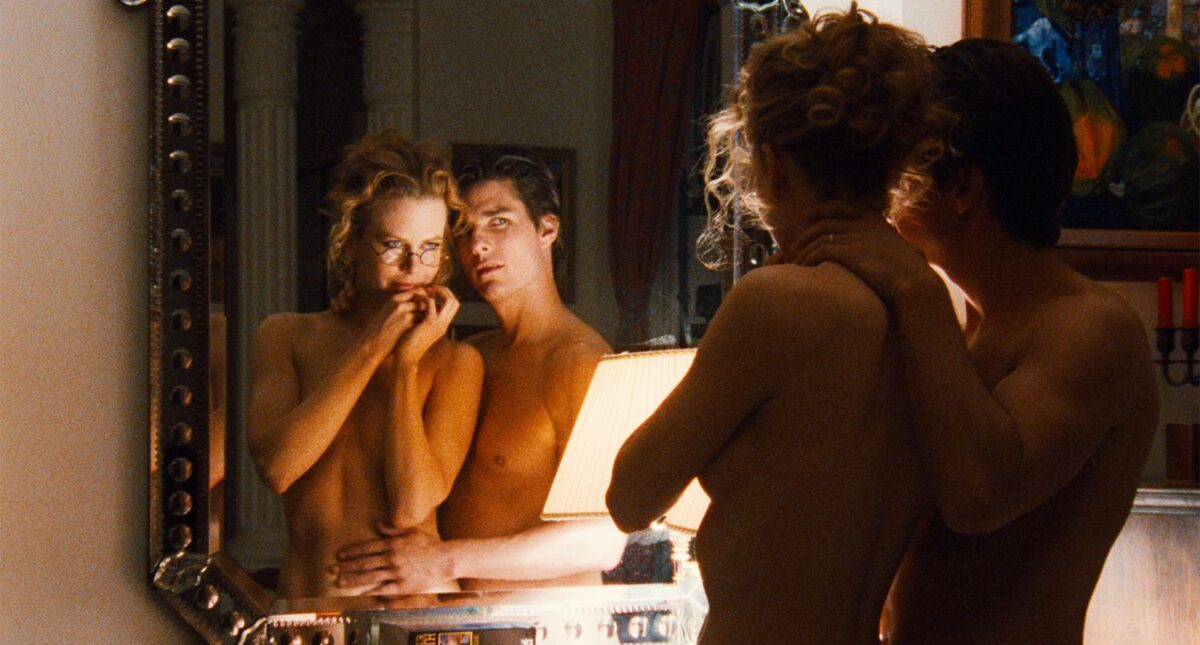
Eyes Wide Shut
One of my favorite things in the Eyes Wide Shut interview that we did was the compare-and-contrast slides of the 2007 Blu-ray with the 2025 4K. When the first stills came out, suddenly everybody’s an expert on what the movie is supposed to look like.
[Laughs]
And it’s fine. People have to talk about something. But I remember popping in that disc, which I got a couple of weeks early and just had to check it out, and again it was that, “Oh, fuck, I have to watch this right now” moment. So you guys are never not subject to that sort of conversation.
Sure.
But when do you guys know that you’re done? I have a beautiful TV, but I drove myself insane calibrating it when I first got it—gamma levels and all that. So for you, what is the point where you say, “Okay, pencils down.”
Well, with Eyes Wide Shut, it was when Warner Bros. and Stanley Kubrick estate gave us the thumbs up [Laughs] and said, “We’re happy with this.” The thing that I found so baffling is that certain factions of the Kubrick audience seem to think that Criterion can just take these films and just do whatever they please to them. And that is absolutely not the case. These are 100% collaborations with the studio—in the case of Eyes Wide Shut, Warner Bros. and the Stanley Kubrick estate. They own the rights to these films. Criterion are sublicensing it. Warner Bros. are saying, “Go ahead, make a 4K master.” But they did the transfer. Before we even got to the color-correct in London, it was already color-matched to an archived 35mm print. So by the time we sat down with Larry Smith, there had already been a color grade to match the original theatrical color grade, which—as we know—is different for whatever reasons.
The video masters that came out in the early 2000s and the Blu-ray—maybe because of the limitations of technology, maybe just because it was too grainy and it would look like mush—is just not exactly how the film looked when it was presented theatrically. Eyes Wide Shut is a heavily grainy film; he force-developed the entire movie. And Nigel Galt, I don’t know if he told you, there was a temporary color correct that he did for Stanley, because he took that work print and he was the one that brought it—Stanley put him on the Concord—to Tom, Nicole, Bob Daly, Terry Semel of Warner Bros. So Nigel handled that. I asked him, ” I know there wasn’t final color because Stanley passed and he didn’t work on it, but was there any kind of temporary?” Nigel said, “Yes.” And they had Larry on the phone constantly. “What did we shoot that at? Where are the time formats?” He told me that Stanley had him reprint a couple of scenes before they showed it to Tom and Nicole.
Unfortunately, and I looked, it appears that that workprint is gone. It just doesn’t exist. Stanley had Leon Vitali destroy his outtakes and workprints and things like that. But we do have the finished print, and I talked to Larry Smith and Nigel Galt separately to get their feelings on Eyes Wide Shut, the old masters, and how it looked theatrically. And they both came back with the same thing: they said it was broadly correct, but parts of it were just way too bright, because there was no need to force-develop the daylight scenes. It was the daylight scenes that they had more of an issue with than the nighttime scenes. Because when there was that much light, why would you need to force-develop the daylight scenes? So they just thought it was a little bit uneven.
So by the time we took it to London and I sat with Larry, Larry’s role was to help kind of find the balance, make sure it wasn’t too grainy, but grainy enough, and also to just kind of watch with the HDR, because with HDR you can make these films look like cartoons if you go way too heavy. And we’re in the realm of digital cinema; we’re in a realm that Kubrick would never have imagined. Even though he worked with Criterion on the LaserDiscs—and I talked to the people who produced the LaserDiscs while I was researching the box set—they are still an analog media. It’s not a digital media. The audio is digital, but the picture is not. So digital cinema is like a completely… Stanley didn’t live, unfortunately, long enough to see the dawning of all this stuff. So what I was told by the people who worked with Stanley on his LaserDiscs: he wanted to keep it as filmic as possible, but understood it’s a completely different medium with its limitations.
So when we took Eyes Wide Shut to London and we were working with Larry, it was really just to make sure that we don’t go over-the-top with the HDR, that it has an evenness to it, and that the grain is there and is prominent, but it isn’t mushy, and is it too distracting? And then we take that master and we show it to Warner Bros. and the Kubrick estate, and they have notes. “We’ve gone back and we’ve looked at that scene; we think that should be a little brighter, we think that should be a little warmer.” “Okay, absolutely.” We show Larry. Larry said, “Yeah, that’s good, that’s good.” So it’s much more of a conversation. It isn’t like we make a transfer and Larry Smith and Criterion come in, turn some knobs and say, “Print.” [Laughs] It doesn’t work that way! Because these films are owned by Warner Bros., they’re owned by the studios. You don’t have carte blanche.
It’s done when everybody is in agreement. “This looks, this is good, and this feels as close to…” I mean, Eyes Wide Shut, it’s a big question mark because Stanley died. So there is no final, final color correct. So it’s tricky. But we know how Leon Vitali worked on the film and helped with the color-timing, and it came out theatrically, and so we match it to that. I think—at the end of the day, after all the debates—people have come around to the fact that the 4K master looks a lot like how the film looks when I saw it in the movie theater over Christmas.
It’s also a big difference when you actually see it in motion and the colors are, operatively speaking, moving around the screen.
100%. 100%. 100%. Because when you pull these things on the Internet, you’re tone-mapping it so you’re not doing any version any justice. You’re not doing the old Blu-ray any justice. One of the things that immediately, when I was working on it, there was a fan scan—somebody scanned a 35mm print of Eyes Wide Shut and it circulates among collectors, torrent people, whatever. So I had that. Well, clearly this looks different than what has come out on video. So that was a touchstone, too. But then when you’re scanning from the original camera negative, it’s a whole other ball game.
I mean, the other thing, too, is—everybody knows this—Stanley was an absolute perfectionist. He wasn’t shitty. So much of the look of the film is baked into the negative itself, and so it isn’t like you could go too far this way or too far that way. I mean, you can royally screw it up by going just too heavy with the HDR or making the colors so garish. But I just matched it to how it looked theatrically, and I think, at the end of the day, people have got to come around. Because it came out in November of last year and Eyes Wide Shut has, weirdly, become a Christmas movie, and people were like, “Oh, I saw it at the cinematheque—it looked like the Criterion master. Yeah, it had all this grain.” But if you’ve only seen the video, if you’ve only seen the Blu-ray, you’re probably thinking, “What the fuck? This isn’t how I remember it.” Which is cool. I mean, I like the Blu-ray; it has its own quality to it.
It’s like, with these new editions, when a new edition of a book comes out. It’s not like you throw away the first printing. You know, you savor it. You say, “Oh, okay, that was…” And that’s kind of how I feel. I mean, for me, I absolutely adore and love that first Stanley Kubrick DVD box set that Warner Bros put out in July of ’99. It was right when Eyes Wide Shut came out. It was the first collection of Stanley’s films on DVD, and they were full-frame, they were 1.33, they had the mono soundtracks on. But people were pissed because they weren’t restored, and so it got pulled pretty quickly. But I coveted that thing when it came out. And so the new set, in some ways, is kind of honoring all these other editions that have come out.
That’s one of the things I’m proudest of: is to look at that credit sheet at the back of the book, and to see Leon Vitali named, to see Janet Wilson, who’s the colorist at Warner Bros., named. To see all these people. To see Martin Hunter, who edited Full Metal Jacket; he was the first person to do a telecine in 1981 or ‘82 for Stanley, and it was The Shining. He worked with Stanley on almost all his telecines in the ’80s; he worked with Warner on the LaserDiscs. It’s just great to see all these names in the credits, because I feel like the Kubrick set is, in a lot of ways, kind of honoring all this work that came before. So it was important for me that all those people were recognized, which is why all the credits: so people can understand who did the color work, who did the transfer work.

A Clockwork Orange
A film like 2001 or A Clockwork Orange, those have 4K studio releases. I assume that those are instrumental in figuring out how you’re going to master it for Criterion.
100%. We couldn’t go from ground zero. It wasn’t like Criterion can just sit there and say, “Okay, we’re going to recolor-correct 2001 based on a print that we’ve…” It’s just like: no. [Laughs] Warner Bros. was saying, “We did this. We have the answer print.” They have materials that you wouldn’t normally be able to access, and they’ve been so generous with all that stuff. But they were totally open to notes. And so there are some subtle changes—especially in The Shining and Full Metal Jacket—just, you know, certain tweaks to put it a little bit more in line, or to put it in line with how the film is presented theatrically. And that goes from metatextual things, like the Saul Bass Warner Bros. logo that’s at the head of The Shining.
Oh, yes.
The previous edition was the newer one. So we said, “Can we put that on? Can we?” “Yeah, absolutely. That’s a great idea. Let’s do that.” You know? It’s like: the end titles of The Shining, for whatever reason—this happened in Stanley’s lifetime—changed color. If you look at the DVD and some of the later video editions, the end titles became white. I’m assuming they did that for legibility’s sake—that the blue would have bled too much—but we said, “Hey, could we change that back to the original theatrical blue?” And Warner Bros. said “sure.” They had looked at the answer print. They said, “You know what, you’re right. They were originally blue, so yeah—let’s do that.”
This all goes back to your original question: when are they done? They’re done when all of the partners are saying, “We’re happy with this.” And that’s the Kubrick estate as well. That’s when it’s done: when everybody kind of signs off. So it isn’t like Criterion can just go and wreck [Laughs] this stuff. The studios have done excellent editions, so that was the challenge: how do we be additive to these editions, and are there any subtle things we can tweak to kind of put them more in line with the way they look theatrically? Which is the 1.85 aspect ratios, the Saul Bass logo at the head of The Shining, and to just not go over-the-top with the HDR so it retains a filmic, warm look. I felt the same way looking at Spartacus, because when I was reviewing all the discs, I was looking at them on a couple of different monitors, and one of the monitors was a perfectly aligned setup and it was like, “Okay, this is really, really nice. Really nice.” And that’s one of the films that, for me, got elevated just personally as I was working on this set. This is an incredibly beautifully photographed film. I’ve never gotten that before.
The last real question I have then is—and sorry if this keeps circling back to online discourse and making it seem like you have to defend yourself, because I don’t think you do—but—
Well, I like the online discourse. I follow all of it. I love the Blu-ray forums; I love the Reddit. I find that stuff really helpful, actually. I mean, the cranky stuff, who cares? Everybody’s entitled to their opinion. But there are a lot of very informed people on these things, and some of them are very funny, so I enjoy that. But in putting this set together, I went and talked to fans—like, people on Facebook. One of the main consultants for me was this guy, Stephen Rigg, who runs the Stanley Kubrick Appreciation Society on Facebook. These are people that have spent their entire lives thinking about and collecting Stanley Kubrick, and they know every iteration of every edition, and so picking their brains and saying, “Look, I’m thinking about doing this. I want to go after this. Has this ever been seen before?” They know.
And there are certain elements on that box set that some of the fans were responsible for—just finding certain things and certain elements. The only time I can’t stand the online discourse is when it attacks people like Larry Smith. It’s like, “Oh, he desecrated Eyes Wide Shut.” It’s such nonsense. You know, I’d rather they say “the producer of this set is a moron” than attack these people who I’m watching work their asses off for nothing. You know? To just put these things out and make them as good as we possibly can.
I got some comments about how Nigel Galt is actually part of the Illuminati because he said that Eyes Wide Shut doesn’t expose the Illuminati.
Right. That’s good: it keeps people talking about the film. So it’s… fine.
And it’s exciting for me because that means I talked to a member of the Illuminati. Imagine how I feel.
[Laughs] I mean, the thing with Eyes Wide Shut I find so baffling is, like: do people realize it is based on a book?
That would require they read a book.
And there’s any number of books written about the various hellfire clubs of the 18th century. It isn’t like rich decadence is some foreign, alien concept. A lot of this stuff is just in the ether as urban legend, or is just totally exaggerated rumor about the rich. Yeah, clearly Stanley knew about all this stuff and was probably as interested as anybody else. But all this stuff is in the Schnitzler book, so… [Laughs] It just so happens that Stanley is prescient, but he’s always been. I mean, 2001 is as relevant today as it was in 1968.
Yeah. I also think understanding Eyes Wide Shut requires having been in a real relationship and having sex, which is a problem for a lot of these people.
[Laughs] Yeah.

The Shining
From my own experience, I know how much work goes into just a barebones disc. Which brings me to this discussion of the price point of the box set. People never say, “Oh, the problem is that it’s too cheap,” right? I have my own experience, I have my own feelings about it, I think you know which way I lean. But I’d like to hear straight from the horse’s mouth about how the pricing of these things is decided. What the thinking is behind some of that? It’s also being released right before the Barnes & Noble sale, which doesn’t seem like a coincidence.
Honestly, I have no part in the pricing discussion. It’s not my domain. What I would say: I have to assume if you’re paying full price, you want it day one. Great! But as you said: there’s the Barnes & Noble sale. And if you don’t want to buy the entire set… first of all, I can tell you: this was an expensive set to produce. Without a doubt. The licensing was really complicated, and not necessarily for the studio films, but all the extra stuff is very complicated, expensive. And as you know, having produced these things, they’re like jigsaw puzzles. It seems like an absurd thing to be complaining about, how challenging it is to put together a DVD, but they are challenging because they do require a lot of diplomacy, a lot of research, and a lot of just exorbitant licensing fees.
There were a couple of things that I would have loved to have included on the set, but it just would have made other things impossible because it’s just too much money. And it’s like: well, the dollars are better spent over here. In terms of pricing: I don’t know because I really don’t know what the manufacturing costs are. That’s a Criterion question.
Got it.
But I can tell you, just from what I’ve seen, some of it is the manufacturing, but a lot of it is the licensing. And none of this stuff is getting any cheaper. But I would say, yeah: wait for the sale. [Laughs] Also, if you’re like, “I’ve bought these. I have, like, half of this set. I bought the 50th anniversary 2001,” I’m working with Criterion now on standalone editions. Because the hope is to get this stuff in the hands of people—particularly younger people who might not have seen these films. That was a big thing for me. We were talking about the box set that came out in 1999; that was a huge thing for me. I was too young to see a lot of these films’ first run. I was born the year Barry Lyndon came out, so video, for me, was my gateway into Kubrick. So we want this stuff to get into the hands of younger people. You want these films to survive. You know, Kubrick’s fan base is so broad. There’s the people who are chapter-and-verse in every scene, and then there’s people who might have only seen one or two, or none at all.
Stanley was, from what I understand—from talking to Martin Hunter, who worked with him on LaserDisc—less perfectionist as people seem to believe. He understood that there were certain limitations. You always try, but if you can’t get it perfect, it’s fine. He was much more interested in people seeing these films, people being engaged in the story. If you’re looking at the number of pixels, you’re not watching the movie—you’re watching your equipment, you know? And I think that he, more than anything else, wanted these films to survive. He wanted to be remembered for his work. For me, that’s the essential thing. How do we push these films forward? I think this set helps us to do that.
I agree.
And hopefully to get it into as many hands as possible. So there will be future Criterion editions—there will be single editions—and I’ve been talking to them about that. That rollout will happen over the next couple of years. The box set is a beautiful thing. It’s a bespoke thing that is kind of the first move in what I think, and what I hope, will be a longer process. Also, doing the set, I have to say, a lot of people haven’t talked in decades—people who are responsible for making these films. Nigel Galt and Larry Smith hadn’t talked in decades. Also, you know, Leon Vitali is no longer here, and other people at the studios have moved on. So this was like a really good opportunity to connect people again, to get people talking, and what I hope is going to make future things possible.
So yeah, again: it just comes back to keeping these films out there, keeping them in the conversation, because I think that, for Stanley, that was really the key. He wanted his films to be remembered. He didn’t want to be thought of as a genius. He didn’t care about that shit. He wanted his films to survive. And I think that this is a good push in that direction.
I mean, I only have the utilitarian label-free discs right now, and I feel that looking at them. So: tip of the cap, job well done. The very, very last thing—and this is kind of a quick, feel-free-to-confirm-or-deny question—but Jennifer Lynch, David Lynch’s daughter, has talked about future Criterion plans for a big Lynch set. I don’t know if you can say anything about that or even know anything about that, but selfishly, I have to ask.
Honestly, I don’t.
Okay.
Because there’s another producer, Susan [Arosteguy], who has worked with David on all the Criterion pieces. I mean, I hope it happens. The Criterion Lynch discs are so amazing, but I don’t have anything to do with that stuff. I’m kind of in and out of Criterion. So I was as surprised as anyone that they were doing a Kubrick set. But I don’t know about the Lynch set. I wouldn’t be surprised if it happened. I hope it happens, but I don’t know. They’re doing Wild at Heart, right? Future plans, I don’t know.
Well, I appreciate you entertaining the invasive question.
[Laughs]
You’re very, very generous with your time. It really is great to hear straight from the horse’s mouth on this, because it feels like this totemic, from-this-point-forward kind of thing you guys have done.
Good, I’m glad. It was challenging, but it was a lot of fun. To just be part of that conversation and to help, just to be talking to you about Stanley Kubrick, and to be part of any serious conversation about Stanley Kubrick is mind-blowing to me. [Laughs] I’m speaking as a fan, and I feel like the impetus behind this was to bring on new people to show them this work and get them excited about this work. But also, as a fan, to do something that would be an event in the Stanley Kubrick universe.
The Complete Kubrick is now available through the Criterion Collection.

The post “He Wanted the Films to Survive”: Michael Chaiken on Assembling Criterion’s The Complete Kubrick first appeared on The Film Stage.
from The Film Stage https://ift.tt/ZXmV9PJ


0 Comments