
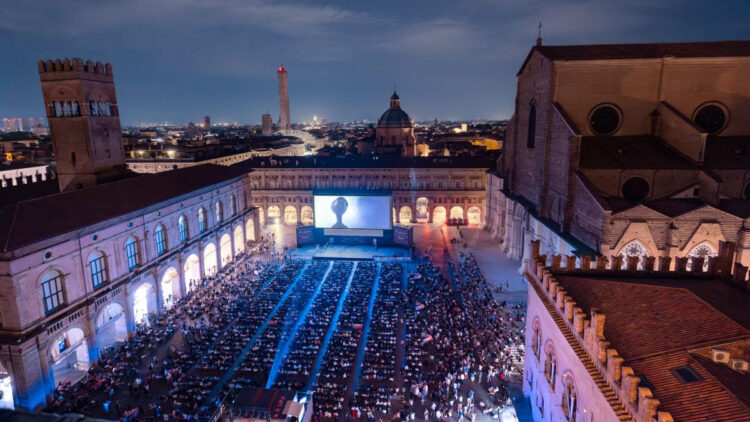
Now in its 40th edition, Il Cinema Ritrovato has swollen to become a true labyrinth of cinema, a Borgesian garden of forking paths that one goes to get lost in. The festival takes place over nine days across 10 or so theaters and comes replete with a 500-page catalogue that weighs you down like a rock as you shuffle through the porticoed streets of Bologna between movies. It’s a cinephile’s dream and it’s hard to describe how magical it feels to watch hundred-year-old silent films or experimental Armenian movies amongst thousands of people seated in the Piazza Maggiore next to a gorgeous 500-year-old Italian cathedral.
The title of the festival translates to the cinema rediscovered and its overwhelming breadth offers a unique opportunity to move past your own film-watching habits and embrace the unknown. With hundreds of films in the program, there’s inevitably a point around the festival’s midway where I almost entirely give up on all of my planning and rationality; I simply let intuition and coincidence decide what movies I’ll watch and walk into screenings with little expectation or foresight. Quoting German theorist Aby Warburg, one of the festival directors advised during the opening ceremony that, “the book you need is always right next to the one you’re looking for.” At Il Cinema Ritrovato I tried to ignore my own wants and let the pursuit of discovery show me what I was really looking for. Here are four highlights which not only amazed me, but, in true Il Cinema Ritrovato form, surprised me.
Pakeezah (Kamal Amrohi, 1972)
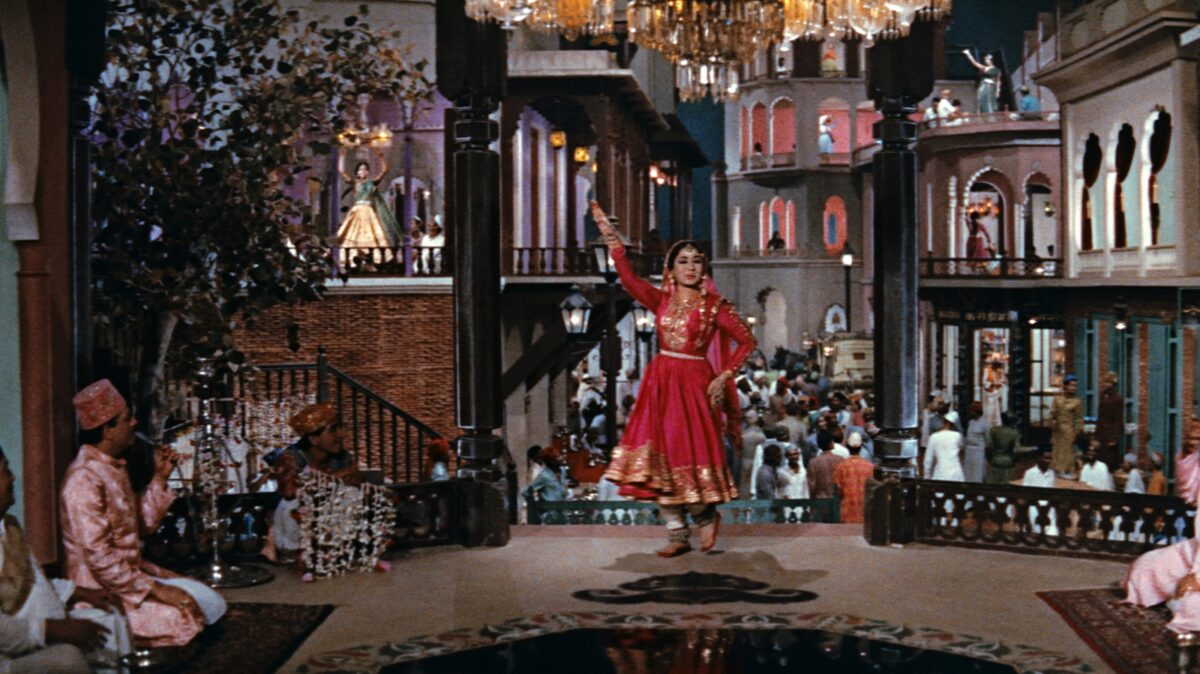
The movie of the festival that brought me closest to Stendhal syndrome, Pakeezah is a sumptuous Urdu musical set in Northern India. Shot over 15 years as the director Kamal Amrohi kept restarting production to move from black and white to Eastmancolor and eventually Cinemascope, the movie has a George Cukor-like conception of how precise visual beauty can craft layers of emotional depth beyond the narrative. The story is a tragic romance between a courtesan, Sahibjaan (Meena Kumari), and a man, Salim (Raaj Kumar), who leaves her a love letter after glimpsing her feet on a train. He calls her Pakeezah, or the pure one, even as she tries to run away from him out of shame over her past. Filmed on lavish sets depicting opulent mansions and massive street scenes, Amrohi utilizes a breathtaking mastery of space, depth, color, and camera movement. The various dances we see Sahibjaan perform as a courtesan are rendered with a sublime contrasting sense of stillness and movement: glacial tracking shots over large, nearly empty chambers contrast with Kumari’s deliberate, methodical spins to create rhythms that are hypnotic and filled with poetic overtones. Whole sequences in the film consist of nothing but camera movements through empty palace rooms––dolly shots around fountains, mirrors, curtains billowing in the wind, crimson carpets with intricate gold lace, the moon in the sky––and the purely aesthetic textures were enough to nearly move me to tears.
L’Enfant Du Paris (Léonce Perret, 1913)
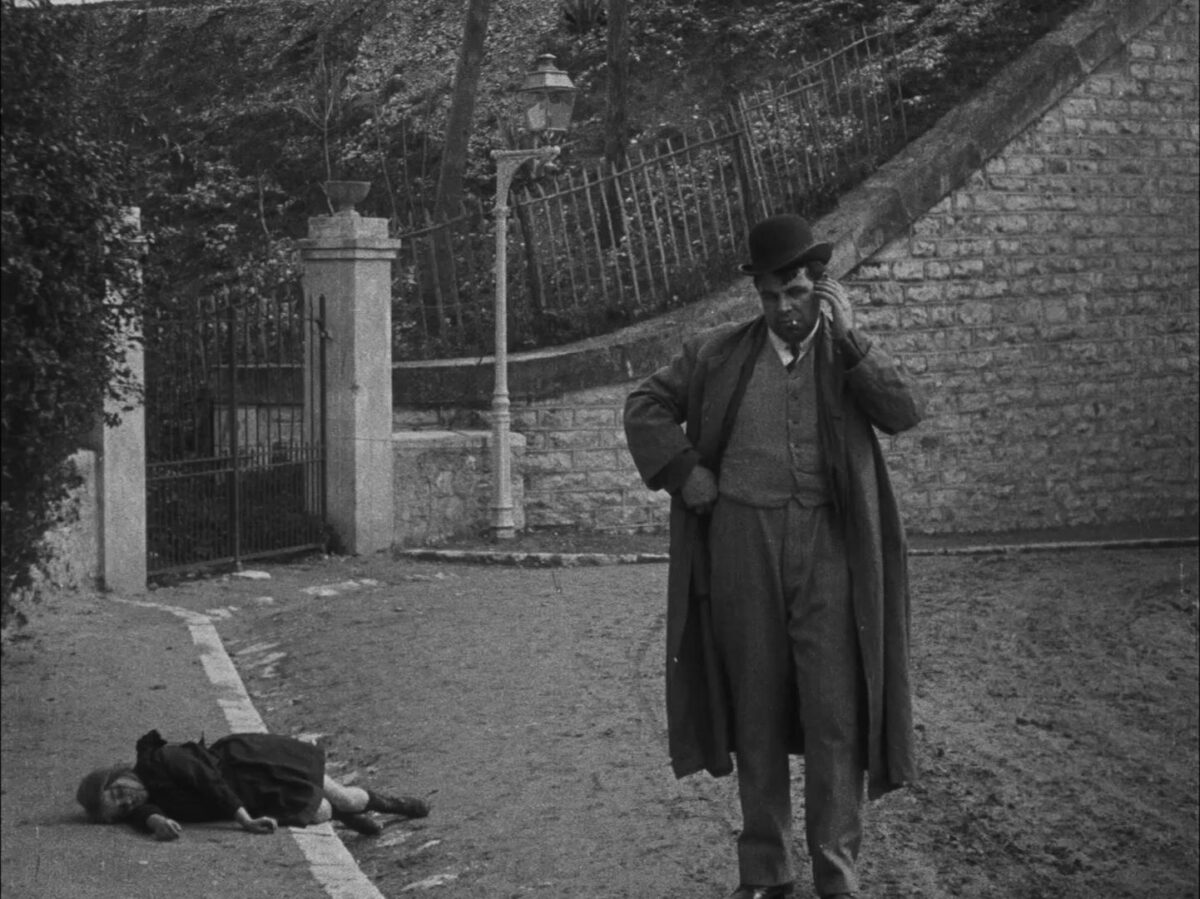
Giving proof to Martin Scorsese’s quip that “whatever you do now that you think is new was already done in 1913,” Léonce Perret’s L’Enfant Du Paris is a work of filmic craft on the highest level that changed my understanding of what the first decades of cinema look like. The story of the search for a small girl orphaned and then kidnapped after her father is presumed dead in a colonial war, the plot echoes Dickens while also looking forward to the crime serials of Louis Feuilluade, who served as producer. While largely a melodrama, and a very effective one too, the film would be remarkable in any time period for how gracefully it pulls off multiple contrasting tonal registers. From thrilling chases across the streets of Paris to documentary street scenes of lower-class saloons to small comic interludes––the film continually moved in surprising new directions without ever losing the emotional thread. In one of the movie’s most striking moments, Bosco, a side character who met the girl while she was kidnapped, unexpectedly becomes the narrative focus for the second half of the plot. Suspense even slowly gives way to leisurely sentimentality when the trail runs cold in Nice and he spends days meandering around the city, broke and crying whenever he passes a doll shop because it reminds him of the girl. Accompanied by a wonderful score by Gabriel Thibaudeau on Piano and Fabiana Sommariva on English Horn, L’Enfant Du Paris epitomized the Il Cinema Ritrovato viewing experience for me in quality, novelty, and revelatory wonder.
By the Law (Lev Kuleshov, 1926)
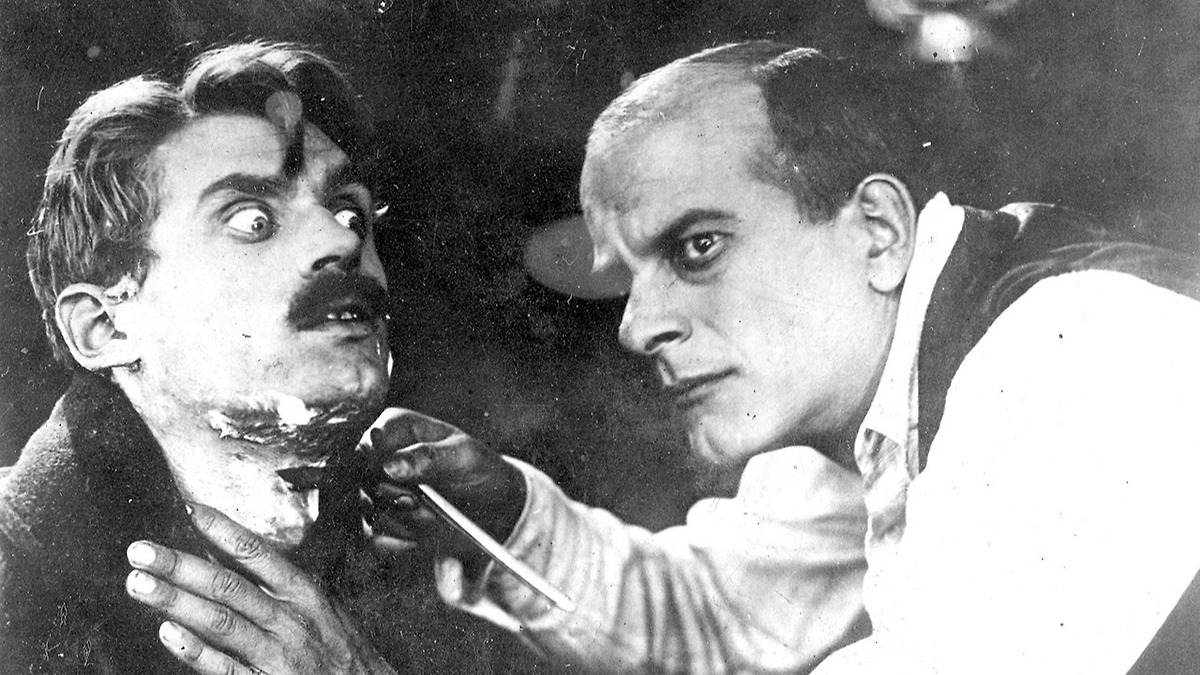
Directed by Lev Kuleshov, who is effectively known as the inventor of psychological editing with the eponymous Kuleshov effect, By the Law is a bleak morality tale based on a Jack London novel. Set in the Yukon Territories, the film is a frontier thriller about a group of prospectors overtaken by madness and murderous instincts on the eve of winter. Snowed and flooded into their cabin for an entire season, the surviving prospectors grapple over their own morality as they watch over their murdering friend, waiting to bring him before the law. Filled with some of the greatest faces of Soviet silent cinema at their most contorted and grotesque (Alexandra Khokhlova, Vladimir Fogel, and Pyotr Galadzhev are the leads) plus beautiful chiaroscuro cinematography that takes good advantage of natural landscapes––ice-breaking, trees blooming, torrential rainstorms––the film is an atmospheric wonder with layers of rich philosophical allegory undergirding it. Brutal and swift like the best pulp art, the film is filled with moments of quick action surrounded by slow descents into regret and moral confusion. While the crimes committed are clear-cut and wrong, Kuleshov fills the proceedings with a heavy sense of ambivalence and fatalism, letting the best characters give into their worst sides and the worst characters demonstrate their most human features so that no one comes out clearly good or evil. The law, for its part, becomes an increasingly obscure and senseless force in absentia, a defining order that, in Kafka-esque fashion, never quite appears, but rules over everything.
Lady in the Dark (Mitchell Leisen, 1944)
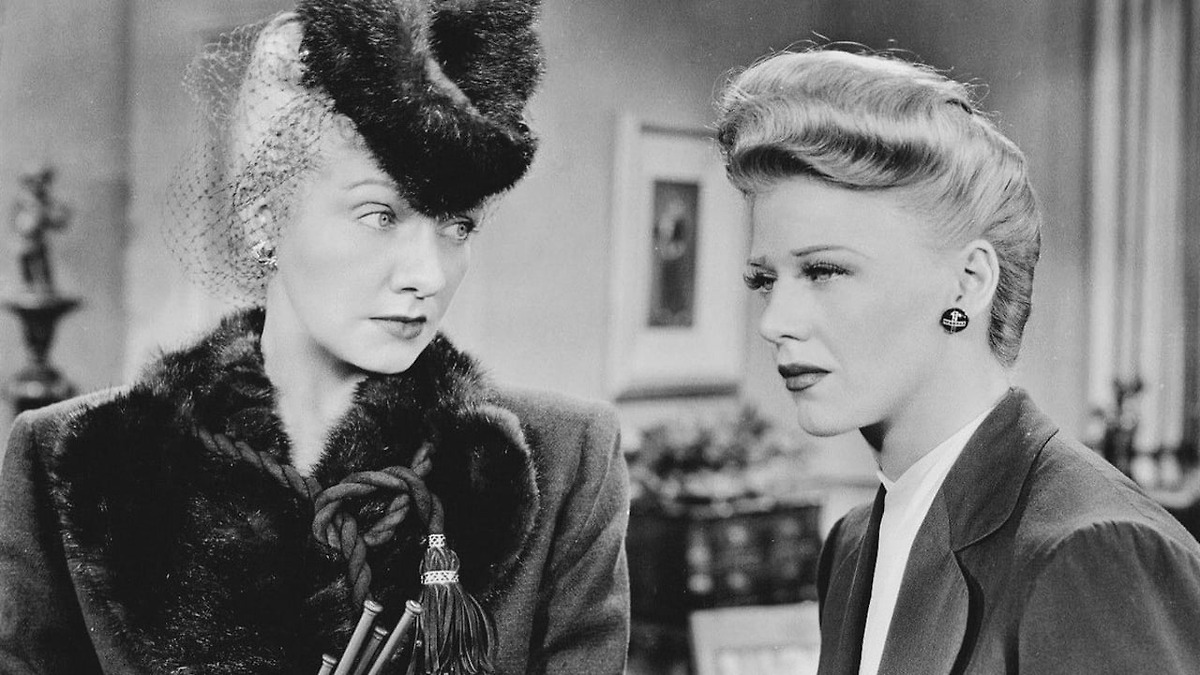
A retrospective dedicated to an undersung auteur of the Hollywood studio system is becoming a staple of the program at Il Cinema Ritrovato. This year’s focus on Mitchell Leisen served as a chance to reevaluate the career of a director whose reputation rests almost entirely on being unrecognized and written off. Often eclipsed by the two most famous screenwriters who worked for him, Billy Wilder and Preston Sturges, Leisen’s relegation to Andrew Sarris’ “Likely Likeable” category in The American Cinema seems like a curse that might never wear off. While I have to admit that after the six films of his I saw at the festival I walked away convinced that Sarris was largely right, what I did discover was how interesting, if highly imperfect, Leisen’s films often are.
A perfect case in point is Lady in the Dark, a Ginger Rogers vehicle that is half a splendorous technicolor musical and half a creaky workplace comedy rife with unfunny jokes and misogyny. Rogers plays Liza Elliott, a fashion magazine editor who goes to psychoanalysis to try to overcome her terrible anxiety. The doctor, ultimately and eye-rollingly, tells her she needs to embrace her womanly side, but before that he asks to hear about her dreams, each of which initiates a fantasy sequence set to Kurt Weill music and Ira Gershwin songs. The less said about the non-fantasy sequences the better, but Leisen, who began his career as a costume designer and art director, has a wonderful eye for visual design and the sumptuous studio sets are the real attraction of the film. From a monochromatic blue ballet to a 30-foot-high gold wedding cake waltz to a circus tent filled with bizarre puppets and Ginger Rogers in a stunning crimson mink dress lined with gold––allegedly the most expensive costume ever created at the time––the film is pure brilliance if you shut your ears to the script and only open your eyes. A pretty movie does not, however, necessarily make for an interesting one, but what actually does make Lady in the Dark worthwhile is an inherent, almost subliminal tension between these lavish sequences, which are all surface yet purport to give a sense of depth to Liza, and the regressively dull real life material, which has little in the way of surface pleasures and too much expository explanation. There’s a schizophrenic nature to the film, its two registers never able to fully complement each other even though they’re ostensibly about one another, and the whole thing comes across as slightly incoherent and never in full control of itself. Yet in this way it’s also true to itself for its a more interesting and authentic psychoanalytical object than many other contemporary films that demonstrate a more coherent grasp of Freudian psychology.
The post Four Must-See Classic Films From Il Cinema Ritrovato 2026 first appeared on The Film Stage.
from The Film Stage https://ift.tt/VGBhN4n


0 Comments