
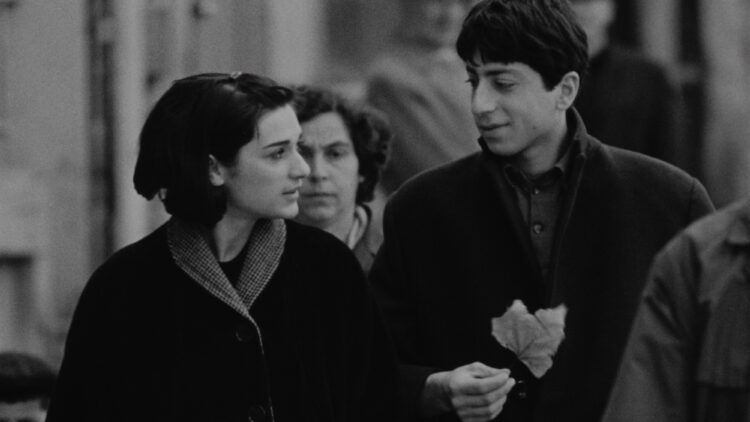
Nobody has ever quite treated images as a building block of narrative and mood like Otar Iosseliani, though you’re forgiven for having no sense of this. A favorite of those who attend the repertory sections of international festivals, the Georgian filmmaker has long been one of world cinema’s well-kept secrets. It’s with some bittersweet appreciation, then, that the secret’s soon out: Cinema Guild has acquired 4K restorations of his work for North American theatrical and home-video releases.
We’re thrilled to exclusively announce they will begin their first big roll-out with “Otar Iosseliani: Fables of Modern Life,” a series commencing at New York’s Asia Society on July 24-25 and continuing at Metrograph from August 8 through 23.
The former is presenting Iosseliani’s first three features—Falling Leaves (1966), Once Upon a Time There Was a Singing Blackbird (1970), and Pastorale (1979)—while the latter gives them an encore and follows through with, to my mind, his greatest achievements: Favorites of the Moon (1984), And Then There Was Light (1989), Chasing Butterflies (1992), and Farewell, Home Sweet Home (1999), along with an early shorts program.
Here’s Cinema Guild’s official rundown of Iosseliani, along with details on each film:
Chronicler of tradition, seeker of things and values (nearly) lost, Otar Iosseliani’s career was divided between his native Georgia and his adoptive home in France, but he remained very much the same filmmaker throughout his long working life: a student of Tati, Dickens, and Buñuel, a master of the long-shot long take, a slyly smiling satirist fascinated and bemused by the remarkable variety of human types, melancholy in contemplation of the tendency of modern society—both the Soviet system and western capitalism—to encourage and indeed enforce uniformity. Following on Asia Society’s premiere presentations of Iosseliani’s Georgian trilogy this July, Metrograph presents the most extensive retrospective of his work to appear in New York in a dog’s age, and a precious opportunity to discover—or revisit—a delightful and sui generis artist, tender, trenchant, and terribly funny.
Otar Iosseliani Early Shorts Program
A program of the inspired early shorts that established Iosseliani at the forefront of a new, rising generation of Georgian filmmakers. Featuring Akvarel, in which a quarreling working-class couple experience a revelation at an art exhibition; Sapovnela, in which an old man who tends exquisite flower gardens in the hills around Mtskheta sees his life’s work threatened by the arrival of a new road; April, in which a young couple find their happiness dwindling as their comfort increases upon moving into a brand new, squeaky clean housing development, and Tudzhi (Cast Iron), a documentary description of life in an ironworks that singles out individuals on the factory floor not as symbols of thrumming Soviet industrial might, but as human beings. Akvarel (1958, 10 mins) Sapovnela (Song About a Flower) (1959, 18 mins) April (1962, 46 mins) Tudzhi (Cast Iron) (1963, 20 mins)
FALLING LEAVES (1966, 91 min, 4K DCP)
Iosseliani’s debut feature—winner of the FIPRESCI Award at Cannes—follows newly minted oenologists Nico and Otar, just out of winemaking school, as they head to work at an agricultural cooperative in Tbilisi, there to have their first intimate experiences of the opposite sex… as well as their introduction to the corruption bred by stifling bureaucracy and arbitrarily imposed production quotas. A stinging satire of Soviet-style economic planning and its unintended consequences smuggled within a pseudo-documentary depiction of the Georgian wine industry, and a deeply personal film about youth for the first time facing up to the full measure of adult negligence and corruption. New 4K restoration of Falling Leaves commissioned by Pastorale Productions. A Cinema Guild release.
THERE ONCE WAS A SINGING BLACKBIRD (1971, 78 min, 4K DCP) preceded by GEORGIAN ANCIENT SONGS (1969, 20 min, DCP)
Gia (Gela Kandelaki), a timpanist in the Tbilisi Philharmonic, has made a science of getting to work just on time to hit his lone cue and then dashing out the door, so as to leave the rest of his hours open for sweet-talking women and carousing with pals. A marvelous character study of an open-handed, incurably impulsive young man infected by the bustling, on-the-go energy of the city around him, and a film that careens along with the same freewheeling spontaneity displayed by its protagonist. Screens with Georgian Ancient Songs, which Iosseliani described thusly: “It’s a film about Georgian traditional polyphony. Georgian songs are always sung in one, two, three or even four voices. It’s a story about how these songs are structured. And at the same time we show what life was like in the old days. The official reaction to the film was one of indignation. I managed to steal a print of the film and keep it safe.” New 4K restoration of There Was Once a Singing Blackbird commissioned by Pastorale Productions. A Cinema Guild release.
PASTORALE (1975, 95 min, 4K DCP)
A Tbilisi-based string quartet, seeking a quiet place to practice, light out for a mountain village, taking lodgings with the family of a long-haul truck driver and rehearsing on the house’s veranda as, around them, the daily life of the mountain hamlet continues unabated, albeit to an incongruous soundtrack of classical music. The film that marks Iosseliani’s decisive turn towards tales in which a community—or, at any rate, an ensemble—act as protagonist, Pastorale, winner of the FIPRESCI Prize at the Berlin International Film Festival, is a work of marvelously polished little moments, not another stereotyped city mouse-country mouse culture-clash but something far more elusive, more insightful, and ultimately more affecting. New 4K restoration of Pastorale commissioned by Pastorale Productions. A Cinema Guild release.
FAVORITES OF THE MOON (1984, 102 min, DCP)
Having relocated to France in 1982, Iosseliani wasted no time in showing the world he hadn’t left his singular gifts behind upon leaving Georgia, taking home the Special Jury Prize at the 41st Venice International Film Festival for this puckish panoramic comedy about dizzying reversals of fortune and everyday acts of larceny, petty and otherwise. Terrorists, chanteuses, antique dealers, police inspectors, street walkers, and street sweepers all have a part to play in this farcical fable located at the intersection of Dickens and Tati, which follows the circulation of two precious objects—a Limoges porcelain dinner service and a portrait of a Belle Époque–era aristocratic beauty—as they’re passed from one pair of hands to another, and up and down the socioeconomic hierarchy, in Paris’s 13th arrondissement. Co-written with regular Polanski collaborator Gérard Brach, and featuring a very fresh-faced Mathieu Amalric in his very first film role.
AND THEN THERE WAS LIGHT (1989, 105 min, DCP)
The confrontation of a traditional rural/agrarian culture bound to the land and the cycles of the seasons and an urban/industrial society that has largely forgotten these ties, an abiding concern of Iosseliani’s cinema, plays out against a backdrop entirely new to his work in this fable-like homage to silent cinema, intertitles and all. In the village of Casamance in southern Senegal, home to the Jola people, life goes on much as it has since time immemorial, with its gossip-mongering, its local scandals, its rituals of field labor and midday meals—until, that is, new European machinery begins to arrive on the scene, its intended use: deforestation of the region and exploitation of its natural resources. “There is an interweaving, an interdependence, of real life and ancient poetry… The film’s texture is not raw, not naturalistic. In Africa, as in his native Georgia, [Iosseliani] enters into a kind of symbiosis with the ‘spirit’ of the country.” —Le Monde
CHASING BUTTERFLIES (1992, 115 min, DCP)
In the French countryside, in a chateau that’s arrived at a state of genteel decay, two eccentric old women live, as they have for years, practicing the nearly forgotten rituals of the prewar haute bourgeoisie, surrounded by beautiful, dusty relics of a bygone era—a stasis soon to be interrupted by a funeral and the arrival of two heirs eager to turn the property into a profit. An intricate network narrative, like Iosseliani’s Pastorale or Favorites of the Moon, Chasing Butterflies is as much about a way of life—or, more accurately, ways of life—as it is about individuals, an elegiac but clear-eyed depiction of a faded, wilting tradition, absurd and touching, about to be blown away by the stiff winds of contemporary capitalism.
FAREWELL, HOME SWEET HOME (1999, 118 min, DCP)
Perhaps the best-loved of Iosseliani’s French productions and the one that earned him the enormously prestigious Prix Louis Delluc, deliciously deadpan formalist comedy Farewell, Home Sweet Home is another of the director’s ensemble narratives, its seemingly disparate, blackout sketch-style segments slowly revealed to be puzzle pieces that form a panorama of high- and lowlife in contemporary Paris. Among the curious characters who flit by is a dissolute upper-class house husband, played by Iosseliani, content to hole up with a bottle and his electric trains while his wife entertains company—a telling image, as the filmmaker here is something like the engineer of a magnificent model train set, transferring from one narrative line to another in some of the most exquisite tracking shots you will ever see.
The post Cinema Guild to Unveil Otar Iosseliani Restorations This Summer first appeared on The Film Stage.
from The Film Stage https://ift.tt/rFxuceB


0 Comments