
It’s Oscar month—perhaps one of the most dreaded times of the year for studios hoping to launch new releases. Not only are Oscar contenders still in theaters or finally hitting them at the tail-end of their rollouts, but winners are going to be re-released in days after the ceremony. Add the fact that nominees are hitting streamers in droves (Neon dropped The Secret Agent and It Was Just an Accident on March 1 on Hulu) and cinephiles’ time becomes very precious.
So you must catch the public’s eye as quickly and as potently as possible. Hit them with a bold title or crazy image or mesmerizing illustration. Force them to start looking towards next year’s Oscars and officially put 2025 in the rearview mirror.
And don’t forget that this is also alt-poster Oscar season for those looking to see the type of ingenuity they wish was present on theater walls. There have been some real doozies hitting social media of late, but these are the five designs I can’t stop thinking about. Check out the artists’ Instagrams for more of their stellar work.


Alessandro Montalto‘s Sentimental Value; Lovas Tibor‘s Bugonia; Pablo Iranzo‘s Marty Supreme; Matt Needle‘s Hamnet; Idea Oshima‘s Sentimental Value with illustration by AICON.
The titles


I’m a big fan of the typography on the poster for Yes (limited, March 27). I don’t necessarily love the design itself and the way the title interacts with the actor’s head, but there’s a great magazine masthead quality to the whole that pops against a wall of glossy photos. The heavy grain helps too.
The juxtaposition of those thin yellow letters with heavy, crisp drop shadows against the bold white sans of the credits is gorgeous and I’m a sucker for a layout that adjusts to its pieces rather than simply adhere to a formula. Because this sheet is very purposefully built as a symmetrical image centered on its y-axis. All the text is positioned in this way along with the subject (besides the duck on his shoulder and the Quinzaine logo tucked into the empty space above it).
The one true outlier is the “a film by” credit. Rather than increase the leading and center it perfectly above Nadav Lapid’s name, the designer utilizes the space provided to them to meticulously fit the words into each other without sacrificing the closeness of the letters due to their extremely tight kerning. The “a film” nestles between the ascenders of the “d” and “l” with the “by” tucking in next to it on the other side of the “l”. The shift isn’t enough to ruin the equilibrium and actually enhances its balance instead.
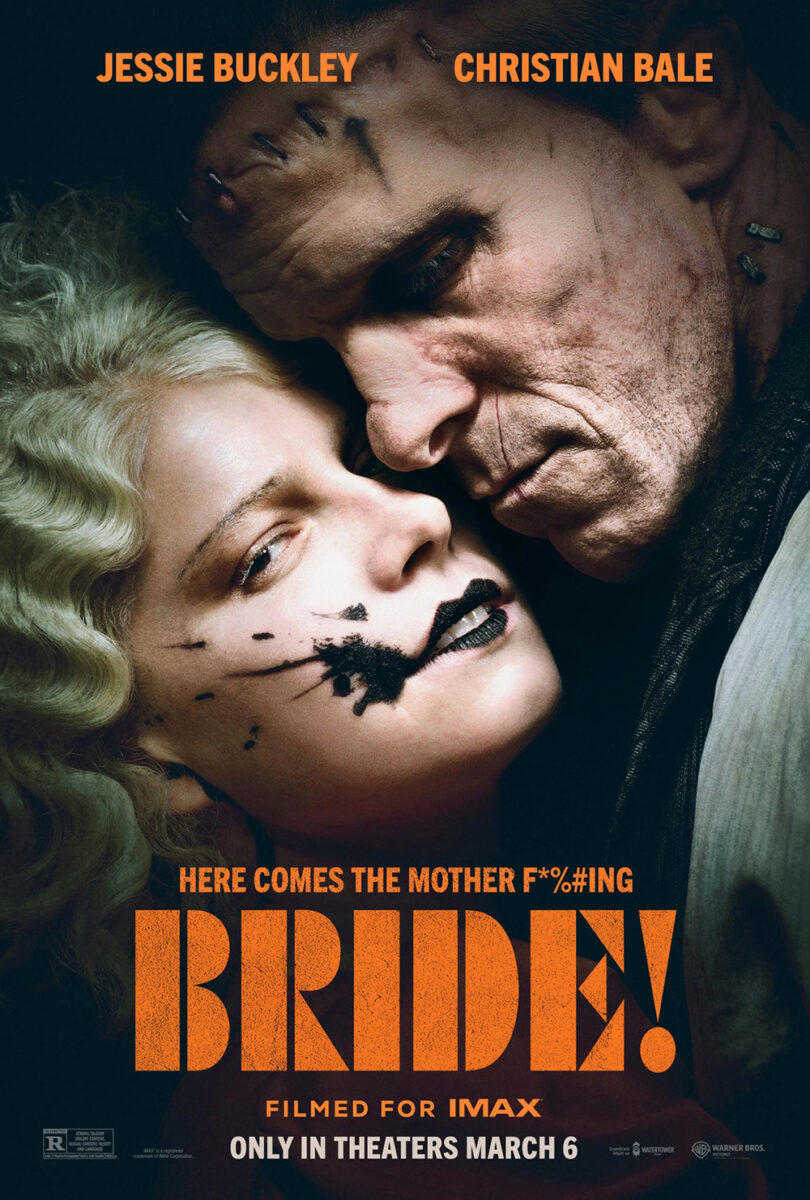
BOND embraces heavy grain as well with the teaser for The Bride! (March 6), but less as a photography effect than a tactile texture. This thing is made to look like it could have been letterpressed onto a thick stock—the black ink soaking in the paper’s pores as the red text is stamped above with just enough translucency to let the former push through. It marries with the aggressive nature of Jessie Buckley’s expression and the censored tagline. And that stencil title font becomes era-specific vintage chic rather than merely a quirky aesthetic flourish.
Because the photo-centric version with both Buckley and Christian Bale does start to skew towards the latter. It’s a great typeface, but it feels a bit forced against the full color image. Goofy rather than boisterous. Like a playbill cover to a showstopping musical instead of a gritty expression of stripped-down rage. Maybe that’s intentional. Without having seen the film yet, my interest is simply piqued by the teaser more.
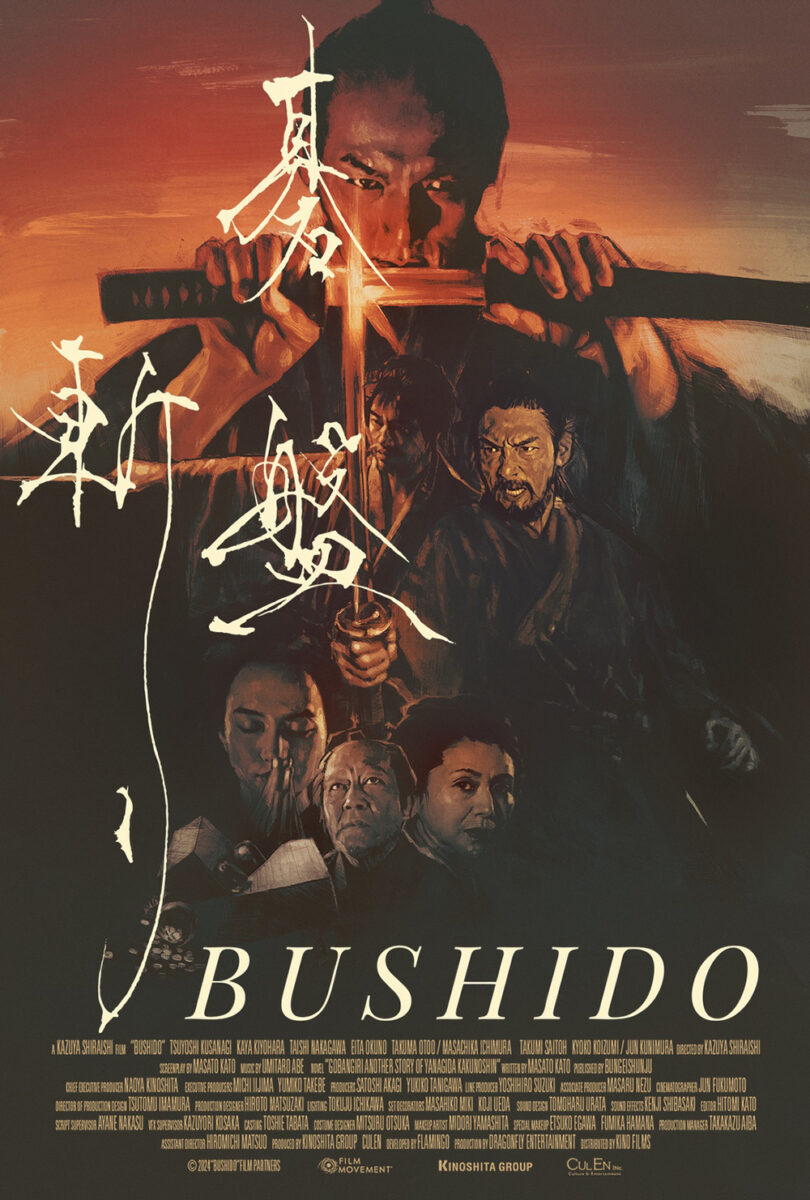
Beyond just the type—although the Japanese characters dripping down the page in thin white strokes is fantastic—the poster for Bushido (limited, March 13) shines because of its refusal to stick to a straight x- or y-axis. The Japanese title looks to be level at the center of the page, but everything else tilts to create motion behind it. The actor’s head pushes forward left as the text all leans backwards right to create the illusion of a crisscross. We feel as though the latter is moving with speed as the former breaks free from the flow to pause everything so our eyes can see.
That simplicity and movement sings for my senses in a way that the second sheet does not. It’s a wonderful painted collage that creates its own crisscross of sword blades, but everything is built straight up and down to lend a more statuesque appearance of formal conservatism as opposed to the excitement conjured by that slight tilt in perspective.
The women


An unforgettable image on its own, the shot used on the poster for Marc by Sofia (limited, March 20) is made more so once you begin to understand what it represents.
I don’t know anything about Marc Jacobs, so I watched the trailer to see if I could discover what I was looking at. Towards the end of the reel is footage of a fashion show where women with giant vintage hairdos are walking around and through giant metal folding chairs. Rather than use a still from that living moment of movement and excitement, however, the one-sheet goes behind the scenes to find one of the models sitting head-down in repose.
The result looks more like a doll than a person, and one could say that’s ostensibly what she is in the context of a fashion show. It’s a fascinating choice that could either be a damning treatise on this read of the industry or a tongue-in-cheek process shot meant to shatter the illusion of severity and drama one might project upon such a high-stakes event. Being that Coppola is Jacobs’ friend, I’ll presume it’s the latter. Either way, you can’t deny the effectiveness of the result.
The poster for Touch Me (limited, March 20) has its own duality of intent as well. Between the title and provocative pose of the actor, one must question whether the silent scream she omits as an effect of a Lovecraftian tentacle wrapping around her neck is born from horror or ecstasy.
To read the synopsis is to reveal the answer is probably the latter: “two friends become addicted to the heroin-like touch of an alien.” This is a scene built to blur the line between pleasure and pain with a color filter and treatment leaning further into that dynamic by making the photography feel almost like a glamour shot portrait.
And while I would generally discredit the title treatment by stacking letters vertically rather than rotating the words ninety-degrees for better legibility, the effect of forcing us to read each letter separate from the whole before comprehending the words slows our descent. It demands we look longer and thus find and interpret that visual contradiction rather than simply choosing what we think is happening and walking away before realizing the other possibility.
GrandSon’s Forbidden Fruits (March 27) teaser also asks us to linger by pushing so far into the actors face that we must pause to fully absorb the scene. To recognize her blood stained skin and how the desire to show us the charms on her tongue renders it a badge of honor rather than an injury in desperate need of mending. This is a punk rock expression evoking strength and attitude to the point where those metal fruits might conceivably be pierced through her flesh rather placed upon it.
It’s in stark contrast to ARSONAL’s poster for Tully wherein the stickers were obviously not put onto Charlize Theron’s face by herself. That’s a beleaguered look of futility whereas the above is a provocation. This is especially true once we realize each fruit represents the woman’s equally bad ass friends.


The final sheet loses that in-your-face impact with its coven line-up and Garbage Pail Kids title treatment. We’ve gone from punk rock to emo pop. A guttural scream to a glitzy catwalk. I’m intrigued to watch the film and see which tone fits best.
The artistry


Let’s face it: if you have Sylvain Chomet’s animation at your disposal, you don’t need to do much more beyond using it. The poster for A Magnificent Life (March 27) proves it by simply giving us a scene of two men and a dog driving towards the camera as a collection of other characters gather around to whet our appetite for the story to come.
What are those spheres in the two men’s hands at left? Why is the guy with glasses and a Chaplin mustache yelling at the right? Even that bug walking up the front of the vehicle makes you pause and wonder whether it’s included as a plot point or mere decoration.
Rather than just rest on the animation itself, however, there’s also that brilliant title treatment to satisfy viewers. It’s a smooth script that feels like paint strokes but appears on the page like paper with every overlapping stroke creating a drop shadow that manufactures an appearance of depth from the whole’s two-dimensional treatment, augmenting the idea of the car also popping out towards us. And the choice to only capitalize the “M” allows the “a” to fit under it and “life” to click into place beneath the “f”. No notes.
I’m also a fan of the way Jillian Adel leans into the indie DIY aesthetic of Dead Lover (limited, March 20) for its scrapbook-like collaged heart. It tells us everything we need to know with Grace Glowicki holding the severed finger of her lost love, while yellow lightning bolts allude to her scientific experimentation to bring him back (the film is yet another recent entry to the “inspired by Frankenstein” canon). We can thus imagine the finished product will be as crudely cut and lovingly assembled as this lo-fi Valentine.
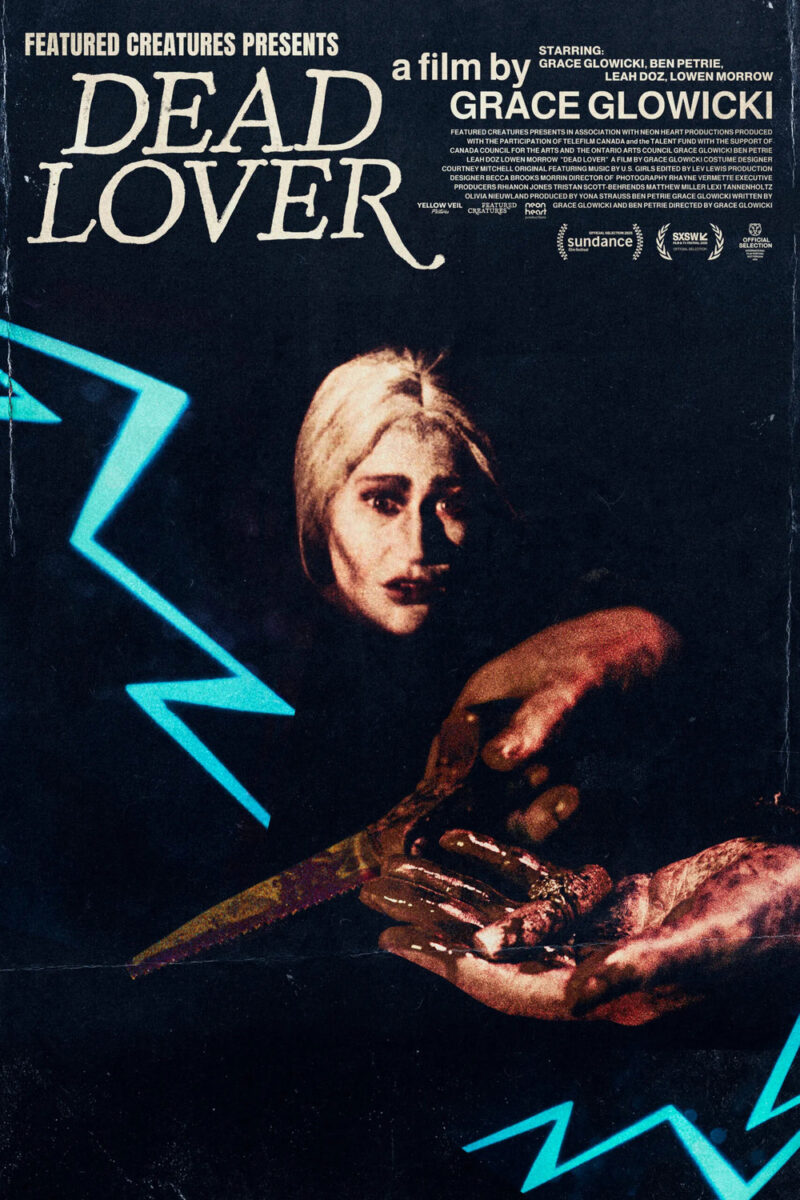
The festival sheet is a bit more overt and bloody in its photographic depiction of the finger and saw that sliced it off. The title arrives via a weathered, all-caps serif instead of strings of cursive as the blue lightning and floating head provide an old-school, practical effects-driven silent-film flavor.
Both posters seem born from the same directive, yet prove completely unique in their respective executions.
And that leaves Ivana Miloš’ use of expressionistic painting to distill Dry Leaf (limited, March 20) into a singular bit of intrigue. Though this drama is about the disappearance of a sports photographer, we see an abandoned soccer goal frame in an overgrown field as oil on canvas instead of light on film.
There’s an almost fantastical element of mystery in this decision that depicts the woman’s absence via the removal of both the place itself and her vision of it. We’re accordingly treated to the scene three times removed—an artistic interpretation of an artistic interpretation.
I also love how it feels as though the paint is encroaching up the page, slowly rising higher with plans to eventually cover the entire frame. The title and credit block are thus pushed to the brink so we can quickly read them before they too disappear into the ether. Memory replacing reality.
The post Posterized March 2026: Dry Leaf, Dead Lover, Touch Me & More first appeared on The Film Stage.
from The Film Stage https://ift.tt/ozjKW0i


0 Comments