
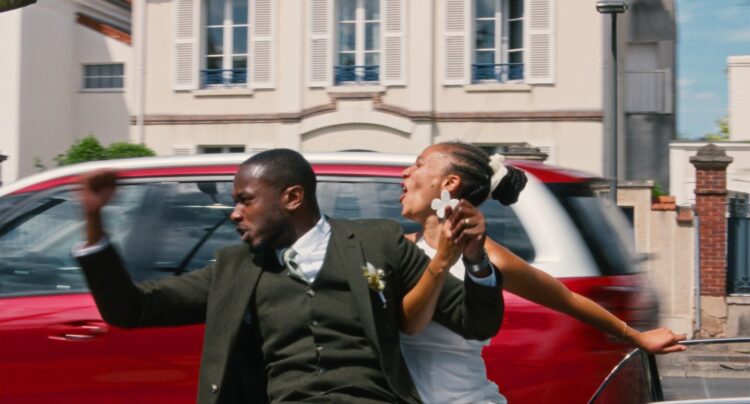

To belong to the diaspora is to inhabit a paradox: a state of in-betweenness, neither fully inside or outside one’s home and adoptive countries. Films trying to map that condition also tend to feel somewhat “suspended,” populated as they are by characters grappling with a double consciousness—“either I’m nobody,” Derek Walcott captured that limbo in his poem The Schooner Flight, “or I’m a nation.” Yet rare are those that weave that interstitial quality into their fabric. Dao, the latest feature by Alain Gomis, a French director of Senegalese and Bissau-Guinean descent, is one such film. A sprawling, often mesmerizing family saga, it straddles two wildly different locales (a country estate in France and a village in rural Guinea-Bissau) and two very distinct ceremonies (a wedding and a funeral). But it also suggests something sitting between two modes of representation, documentary and fiction, blending myth and autobiography into a stupefying epic.
“Every film is a documentary of its own making,” Jacques Rivette once said. Dao foregrounds that from the opening sequences: a string of casting sessions in which Gomis introduces his characters through the actors playing them. “This is going to be a real fake family,” he warns his prospective thespians, and among the women auditioning in a nondescript rehearsal room, the camera singles out Katy Correa. She is one of many non-professionals starring in what amounts to a sort of family project for Gomis, who fills this diptych with a whole gang of relatives. Correa, a real-life mother of one, is Gloria, a fictional mother of one to twenty-something Nour (played by actress D’Johé Kouadio). But to harp on the distinction between “real” and untrained performers would be to insist on just the kind of boundary this shapeshifting film is pushing against. Dao is perched on the tenuous border between truth and fiction—it’s a work that feels most electrifying at the very moments when that divide is lifted.
Conceived just after Félicité, Gomis’ 2017 Berlinale Competition entry and Grand Jury winner, Dao finds the director reenacting personal memories: his father’s burial in Guinea-Bissau and a wedding in France that followed some years later. But the chronology here is far more ambiguous, and the film seamlessly dances between the two events as though they existed on the same timeline. That’s in keeping with the philosophical concept behind the title: “a perpetual circular movement,” an onscreen text explains, “which flows in everything and unites the world.” Life and death coexist in Dao, spilling into each other and growing outward like ripples on water. We follow Gloria and Nour as they meet distant relatives in ancestral Guinea-Bissau who’ve come to mourn the death of Gloria’s father—only to be catapulted back to Europe to celebrate Nour’s wedding and bolt back to the “native” turf again. That should make for a dizzying journey, and indeed Dao unfurls as a kinetic ballet restlessly zigzagging between the two rituals.
But in Gomis’ hands, burial and nuptials speak to the same purpose: these are, first and foremost, family gatherings where far-flung people reunite to suture old bonds and forge new ones. We hear about childhood anecdotes and dying traditions, long-gone relatives and estranged ones showing up uninvited; there’s bickering and reconciliation, ghosts, plenty of alcohol, a cow, and a lamb slaughtered for the village. Mostly though, in France and Guinea-Bissau both, there’s life: endless, exuberant, joyous. Dao is a much different and arguably more ambitious affair than Félicité, but like its predecessor, even at its most harrowing it refuses to wallow in misery—for a film partly concerned with people in mourning, none of it ever feels sepulchral.
At three hours, Gomis’ cross-continental odyssey can sometimes lag, and there’s no denying the diffuse, drawn-out approach. But those longueurs are the very reason Dao is the rare film that invites you not to watch these characters so much as spend time with them. Gomis isn’t all that bothered with fleshing them out. The cast is so immense that most guests—save for Gloria, Nour, and a handful of others—come and go, leaving you barely enough time to catch their names. But his film nonetheless fosters a scorching intimacy between audience and characters, in no small part a function of his three cinematographers, among them Céline Bozon, here embracing the same handheld style with which she’d shot Félicité—all throughout, the lens pushes so close to these people as to reach a sort of epidermic alchemy with their bodies. That curious, buoyant camerawork—as well as the film’s soundscapes, mixing blues by Abdullah Ibrahim and tracks from Gomis’ own nephew Gaspard—offer connective tissue between the two continents. Dao doesn’t unfold through scenes, exactly; nothing ever begins or ends here. Instead it serves up shards of life captured on the fly, with the raw immediacy of material that’s still hot to the touch.
There is something riveting about the attention with which Gomis surveys these worlds and listens to the stories that bind its dwellers. Dao is a journey of self-discovery for characters and filmmaker alike, and—at the risk of eliding Nour or any of the most significant figures trying to navigate their deracinated identities—I like to think the closest Gomis comes to finding an avatar is Gloria herself. To the extent that a work so polyphonic can be said to have a leading voice, she traverses Dao as its principal witness. So much of it finds Correa watching, listening, soaking up things in wide-eyed wonder: a heated conversation at the wedding over homosexuality and polygamy; the sudden appearance of an old lady at the funeral, seemingly possessed by a spirit. Gomis crafts Gloria as a link between past and future, a guide helping Nour to wade through two “homes.” Born in France to a father who then moved back to Guinea-Bissau, she stands as a chronic outcast, but nothing about the dignified way Correa embodies her triggers pity. Like Véro Tshanda Beya Mputu, who played the title role in Félicité, Correa is a first-timer, but Gomis isn’t concerned with the supposed asymmetry between her performance and those of the professional actors around her, not least because no line she utters feels stilted.
Late into the film, she sits next to Nour’s father, her former partner Slimane (Samir Guesmi). The wedding’s almost over, his infatuation for her is not, and across a single unbroken shot, he tentatively flirts with her, only to be gently rebuffed. I have no way of knowing if any of it was scripted—so effortless is their repartee, the moment seems totally improvised—but it’s a beautiful encapsulation of the kind of pleasures Dao elicits: the feeling of watching life unfolding before your eyes.
Dao premiered at the 2026 Berlinale.
The post Berlinale Review: Alain Gomis’ Dao is a Riveting Family Saga first appeared on The Film Stage.
from The Film Stage https://ift.tt/fEToC1K


0 Comments